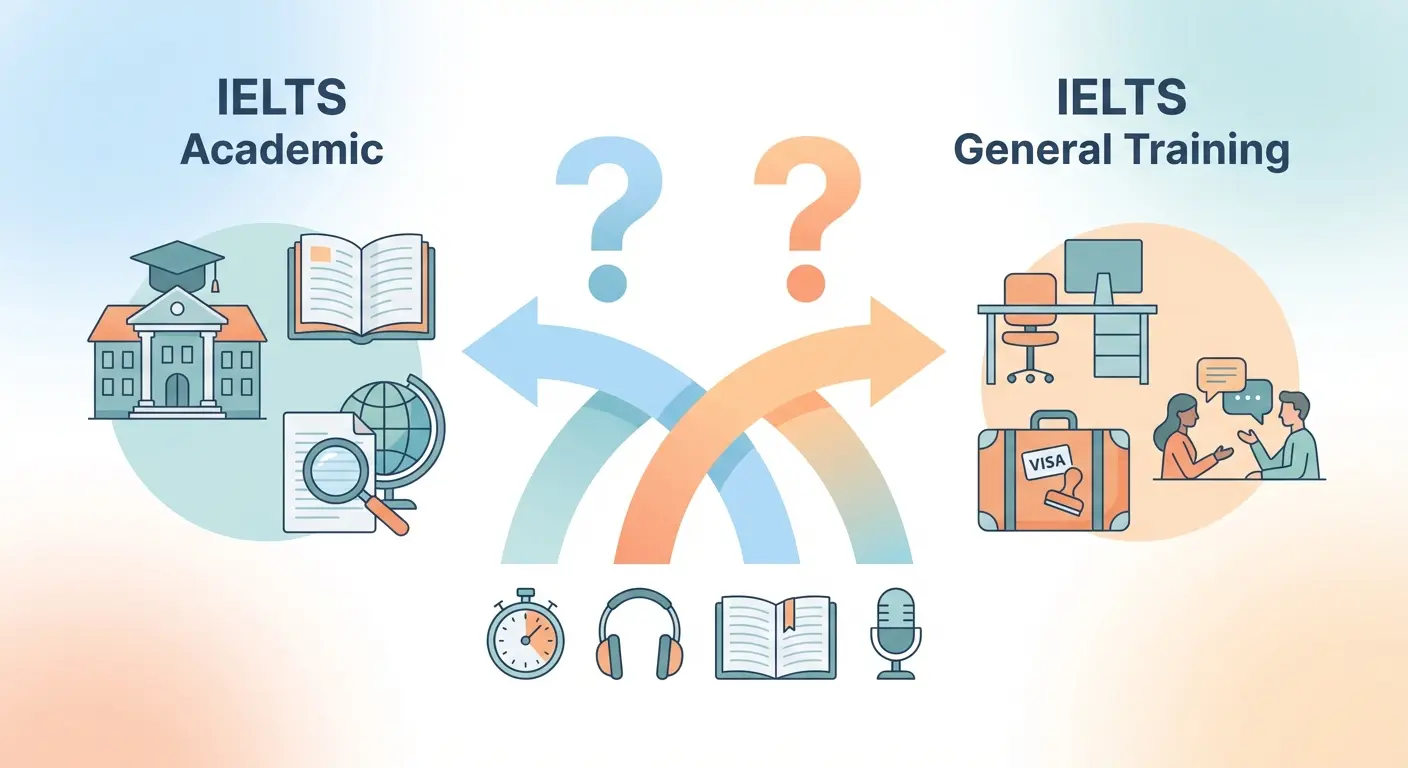
IELTS Academic vs General Training: Which Should You Choose?
IELTS Academic vs. General Training: The Ultimate Showdown – Which Test Is Right for YOU?
So, you’ve decided to take the IELTS. Fantastic! 🎉 It’s a globally recognised English proficiency test and a key requirement for millions of people aiming to study abroad, immigrate, or work in English-speaking countries.
But very quickly, one confusing question appears:
IELTS Academic vs. General Training – which one should I take?
This is not a small decision. While both tests assess your English across Listening, Reading, Writing, and Speaking, they are designed for very different purposes. Choosing the wrong one can waste time, money, and even derail an application.
This guide will clearly explain:
- •
Who each test is for
- •
How the sections differ (and which ones don’t)
- •
Real-world examples
- •
How to confidently choose the right IELTS module for your goals
Let’s break it down.
Why Are There Two IELTS Tests?
IELTS exists to measure English ability for different life paths. Not everyone uses English in the same way.
IELTS Academic
Designed for academic and professional environments:
- •
University lectures
- •
Research papers
- •
Academic textbooks
- •
Formal reports and essays
IELTS General Training
Designed for everyday life and work:
- •
Workplace communication
- •
Immigration requirements
- •
Daily reading and writing tasks
- •
Social and professional interaction
In short:
- •
Academic = study & academic professions
- •
General Training = immigration, work & daily life
Who Should Take IELTS Academic?
You should take IELTS Academic if:
- •
You are applying to universities or colleges (undergraduate or postgraduate)
- •
You need English for professional registration (medicine, nursing, engineering, law, teaching)
- •
You are applying for scholarships or research programmes
- •
You plan to work in a profession that requires academic-level English
Example: Sarah is applying for a Master’s degree in Australia. Her university requires IELTS Academic 7.0. ➡️ Academic is her only valid option.
Who Should Take IELTS General Training?
You should take IELTS General Training if:
- •
You are applying for immigration (UK, Canada, Australia, New Zealand)
- •
You need English for work visas
- •
You are enrolling in vocational or training programmes
- •
You are applying for secondary education
- •
You need proof of practical, everyday English
Example: David is applying for permanent residency in Canada as a skilled worker. Immigration requires IELTS General Training. ➡️ Academic would not be accepted.
Section-by-Section Comparison
Listening (Same for Both)
The Listening test is identical for Academic and General Training.
What you’ll hear:
- •
Everyday conversation (e.g. booking accommodation)
- •
Everyday monologue (e.g. local information)
- •
Educational discussion (e.g. students and tutor)
- •
Academic lecture
Key point: Listening skills are essential for everyone—students and migrants alike.
Speaking (Same for Both)
The Speaking test is also identical.
Three parts:
- •
Personal questions (home, work, studies)
- •
Long turn (speak for 1–2 minutes)
- •
Discussion (more abstract questions)
Key point: You are marked on fluency, coherence, vocabulary, grammar, and pronunciation—not on whether you are Academic or General.
Reading: Where the Big Difference Starts
IELTS Academic Reading
- •
3 long academic texts
- •
Taken from journals, books, and academic articles
- •
Complex vocabulary and sentence structures
- •
Focus on:
- •
Arguments
- •
Evidence
- •
Abstract ideas
- •
Author’s opinion and purpose
Example texts:
- •
Climate change research
- •
Historical analysis
- •
Scientific developments
This section requires strong analytical reading skills.
IELTS General Training Reading
- •
3 sections, texts increase in difficulty
- •
Everyday and workplace materials:
- •
Job ads
- •
Notices
- •
Instructions
- •
Company policies
- •
Magazine articles
Example texts:
- •
Workplace safety rules
- •
Library information
- •
Community announcements
This section tests practical reading skills, not academic analysis.
Writing: Completely Different Tasks
IELTS Academic Writing
Task 1 (150 words):
- •
Describe a graph, chart, table, or diagram
- •
Focus on trends, comparisons, and key data
Task 2 (250 words):
- •
Write a formal academic essay
- •
Discuss arguments, causes, effects, or opinions
Key skills:
- •
Formal tone
- •
Data interpretation
- •
Academic vocabulary
- •
Structured arguments
IELTS General Training Writing
Task 1 (150 words):
- •Write a letter
- •Formal (complaint, request)
- •Semi-formal (work-related)
- •Informal (friend or family)
Task 2 (250 words):
- •
Write an essay on a general topic
- •
Less academic, more practical
Key skills:
- •
Clear communication
- •
Appropriate tone
- •
Everyday vocabulary
- •
Logical organisation
Quick Comparison Table
How to Choose the Right Test (Simple Checklist)
Ask yourself:
- •Why am I taking IELTS?
- •Study or licensed profession → Academic
- •Immigration or work → General Training
- •What does my institution or visa authority require?
- •Always check official requirements (never guess)
- •What type of writing am I more comfortable with?
- •Graphs and formal essays → Academic
- •Letters and general topics → General Training
Once you answer these honestly, the decision becomes very clear.
Common Mistakes to Avoid
- •
❌ Taking General Training when Academic is required
- •
❌ Assuming immigration always uses General Training (some exceptions exist)
- •
❌ Thinking General Training is “easy” (it still requires strong English)
- •
❌ Preparing for the wrong Writing Task 1
Choosing the wrong module can mean retaking the test, so double-check before booking.
Final Thoughts
The IELTS Academic vs. General Training difference is not about difficulty—it’s about purpose.
Choose the test that matches:
- •
Your goals
- •
Your application requirements
- •
The English you actually need to use
Once you choose correctly, your preparation becomes more focused, more efficient, and far less stressful.
Key Takeaways
- •
Academic = study & academic professions
- •
General Training = immigration, work & daily life
- •
Listening and Speaking are the same
- •
Reading and Writing are very different
- •
Always verify official requirements before registering
Ready to prepare for the right IELTS test? Start practising with materials designed specifically for your chosen module and give yourself the best possible chance of hitting your target band. 🚀
Next best action
Move from strategy to score gains with a targeted practice step.