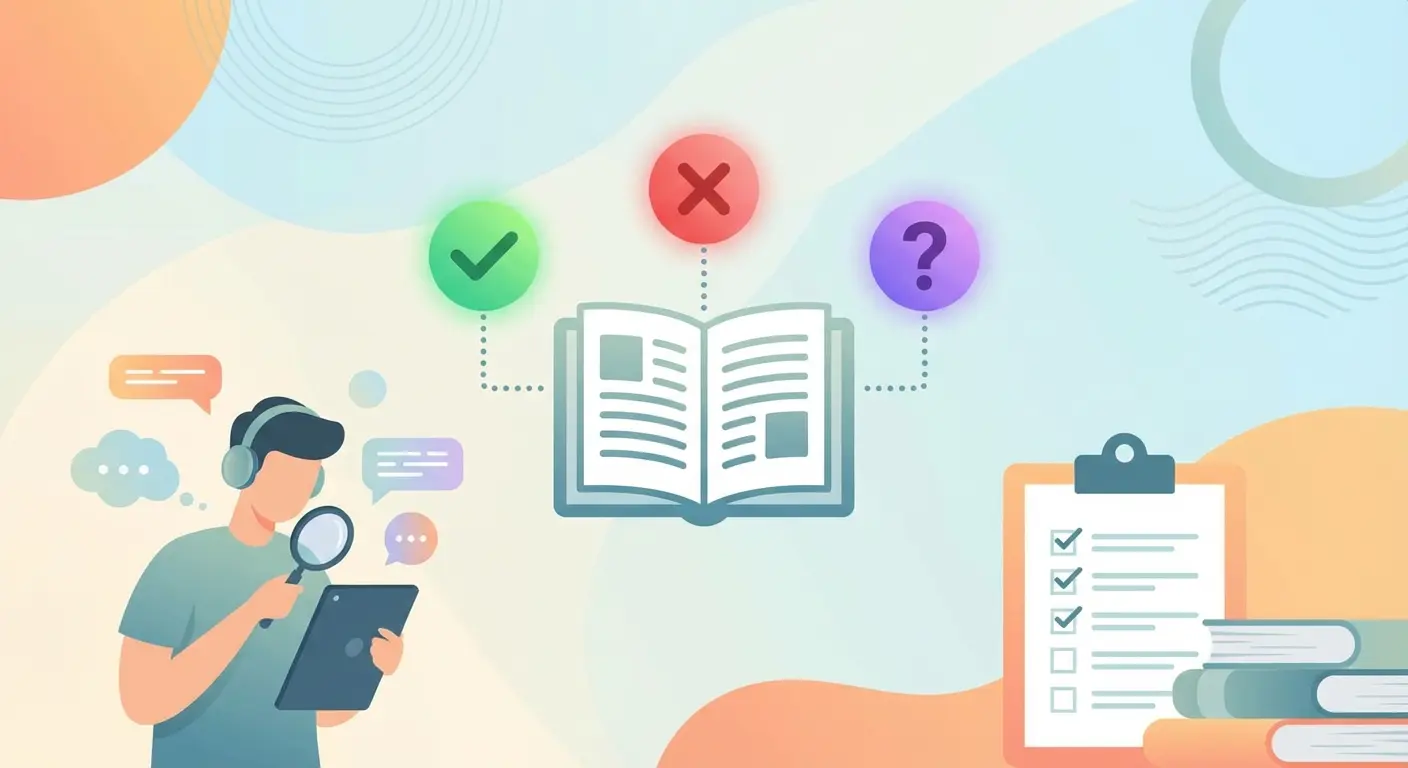
Tackling True/False/Not Given Questions in IELTS Reading
Tackling True/False/Not Given Questions in IELTS Reading: Your Ultimate Guide to Mastering the Tricky Trifecta
Hey IELTS warriors! It’s your friendly neighbourhood IELTS instructor here, ready to dive deep into one of the most… infamous sections of the IELTS Reading test: the True/False/Not Given questions. I see the collective groan from here! These questions can feel like navigating a labyrinth blindfolded. You’re presented with a statement, then you’re sent into the reading passage to find proof, and suddenly, your brain starts doing somersaults.
But fear not! Today, we’re going to demystify this question type. We’ll break down exactly what “True,” “False,” and “Not Given” really mean, equip you with a bulletproof strategy, and arm you with the knowledge to conquer this challenge. By the end of this post, you’ll be approaching these questions with confidence, not dread. Let’s get started!
The Crucial Clarification: Understanding True, False, and Not Given
Before we even think about strategies, we need to be absolutely crystal clear on the definitions. This is where many students stumble. They confuse “False” with “Not Given,” or they think a slight variation means “False” when it’s actually a perfect “True.”
True: The Unwavering Agreement
A statement is TRUE if the reading passage explicitly states the same information. This means you can find direct evidence in the text that fully supports the statement. It’s not about paraphrasing; it’s about direct, undeniable confirmation.
- •Think of it like this: You're a detective, and the statement is your suspect's alibi. "True" means you've found irrefutable CCTV footage or multiple witnesses confirming that alibi.
- •
Example:
- •
Statement: The study found that 70% of participants reported improved sleep quality.
- •
Passage: "The research indicated a significant positive correlation with sleep, with precisely three-quarters of individuals involved in the trial experiencing a marked enhancement in their nightly rest."
- •
Analysis: Three-quarters is 75%. The statement says 70%. This is not a direct match. However, if the statement had said "over two-thirds," then it would be True. Let's refine our example for a clear True:
- •
Statement: The study found that a significant majority of participants reported improved sleep quality.
- •
Passage: "The research indicated a significant positive correlation with sleep, with precisely three-quarters of individuals involved in the trial experiencing a marked enhancement in their nightly rest."
- •
Analysis: "Significant majority" is supported by "three-quarters." This is TRUE.
False: The Direct Contradiction
A statement is FALSE if the reading passage directly contradicts the information presented in the statement. The passage might present opposite information, or it might state something that is the exact opposite of what the statement claims.
- •Think of it like this: Your suspect's alibi is busted. You have evidence that they were actually at the scene of the crime, not where they claimed to be.
- •
Example:
- •
Statement: The new technology is expected to reduce production costs by half.
- •
Passage: "While the implementation of the new technology will streamline processes, initial estimates suggest it will actually increase operational expenses by approximately 15% in the first year."
- •
Analysis: The statement claims a reduction, while the passage states an increase. This is a direct contradiction. This is FALSE.
Not Given: The Unseen Evidence
This is where things get tricky, and it’s the most common pitfall. A statement is NOT GIVEN if the reading passage does not provide any information about the statement, either to confirm or deny it. It doesn't mean the statement is incorrect; it simply means the information isn't present in the text you've been given.
- •
Think of it like this: You're investigating a case, and the suspect's alibi is about their favourite colour. Does the suspect have a favourite colour? Maybe. Does the passage mention it? No. Therefore, you cannot confirm or deny their favourite colour based on the evidence.
- •
Key Point: Do NOT assume something is "Not Given" just because it's not stated in the exact same words. You must scan for the concept. If the concept isn't there at all, then it's "Not Given."
- •
Example:
- •
Statement: The company plans to release a new product line in the next fiscal quarter.
- •
Passage: "The company is currently focusing on optimising its existing product range and has no immediate plans for expansion into new market segments. Analysts are optimistic about their current stock performance."
- •
Analysis: The passage talks about optimising existing products and no immediate plans for expansion into new market segments. It doesn't mention a "new product line" specifically, nor does it mention the next fiscal quarter. While it implies no expansion, it doesn't deny a new product line. The information about a new product line in the next fiscal quarter is simply absent. This is NOT GIVEN.
A Quick Table to summarise:
The Ultimate Strategy: Keywords, Scanning, and Careful Comparison
Now that we're clear on the definitions, let’s talk about how to find the answers efficiently and accurately. This is where your IELTS Reading superpowers come into play!
Step 1: Understand the Statement Thoroughly
Before you even glance at the passage, read the statement carefully. Identify the core subject and the key pieces of information being presented. Ask yourself:
- •
What is this statement about?
- •
What specific claims is it making?
- •
What are the most important words (keywords) that I need to find in the passage?
Step 2: Underline Keywords and Concepts
Once you understand the statement, underline or highlight the keywords. These are the words that are most likely to appear in the passage, either in their original form or as synonyms. Think about:
- •
Nouns: Specific people, places, things, concepts.
- •
Verbs: Actions or states of being.
- •
Adjectives/Adverbs: Descriptive words that convey specific qualities or quantities.
- •
Numbers/Dates/Quantities: These are often very specific and easy to locate.
Example:
- •
Statement: The ancient Egyptians used hieroglyphs to record their history, religious beliefs, and daily life.
- •
Keywords to underline: ancient Egyptians, hieroglyphs, record, history, religious beliefs, daily life.
Also, consider the concept behind the keywords. For example, if the statement mentions "a significant increase," you'd look for synonyms like "a substantial rise," "a large jump," or even numbers that indicate a large increase.
Step 3: Scan the Passage for Keywords
This is where your scanning skills are crucial. Don't read the passage word-for-word. Instead, quickly skim through the relevant sections of the text, looking for your underlined keywords or their synonyms.
- •How to Scan: Move your eyes rapidly across the text, looking for specific words or phrases. You’re not trying to understand every sentence, just to locate potential matches.
- •Focus on Paragraphs: Try to identify which paragraph(s) are likely to contain the information you need. If your keywords relate to "ancient Egyptians" and "hieroglyphs," you'll likely find it in a paragraph discussing their culture or writing system.
Step 4: Read the Relevant Section Closely
Once you’ve found a section of the passage that seems to contain your keywords, slow down. Read that specific paragraph or sentences very carefully. Now, your goal is to compare the information in the passage with the statement.
Step 5: Compare and Decide: True, False, or Not Given?
This is the critical decision-making stage.
- •If the passage directly supports the statement: It's TRUE. Look for the exact same meaning, even if the wording is different.
- •
If the passage directly contradicts the statement: It's FALSE. Find the opposite information.
- •
If the passage doesn't mention the information at all: It's NOT GIVEN. This is where you need to be disciplined. If you can’t find any information about the statement's core claim, then it’s Not Given.
Important Caution: The "Not Given" Trap
Many students make the mistake of choosing "Not Given" when the correct answer is actually "False," or vice versa. Here’s how to avoid it:
- •Don't confuse lack of information with contradiction. If the passage doesn't say anything about a specific detail mentioned in the statement, it’s "Not Given." If it says the opposite, it's "False."
- •
Be wary of information that is related but not identical. For example, if a statement says "The Amazon rainforest is the largest rainforest in the world," and the passage says "The Amazon rainforest is a vast and diverse ecosystem," this is NOT GIVEN because the passage doesn't explicitly state it's the largest. It might be, but the text doesn't confirm it.
- •
Consider the scope. If a statement is very specific, and the passage is more general, it might be "Not Given."
practise Makes Perfect: Variety is Key
To truly master True/False/Not Given questions, you need to practise with a wide variety of passages and question types. Different topics (science, history, social issues) will present different vocabulary and sentence structures, which is excellent for building your skills.
Types of Statements to Watch Out For:
- •Statements with Specific Quantities/Numbers:
- •Statement: The project received funding of £5 million.
- •Passage: The project secured financial backing of over £4.5 million.
- •Analysis: This is NOT GIVEN. The passage doesn't confirm exactly £5 million. It could be £4.6 million, £4.9 million, or £5.1 million.
- •Statements with Absolutes (Always, Never, All, None):
- •Statement: All students found the lecture to be challenging.
- •Passage: Most students reported that the lecture was somewhat difficult.
- •Analysis: This is FALSE. "All" is absolute, while "most" and "somewhat" indicate a majority but not totality.
- •Statements with Opinions or Predictions:
- •Statement: The author believes that artificial intelligence will replace human doctors by 2030.
- •Passage: The author discusses the potential for AI to assist in medical diagnosis, but emphasizes that human oversight will remain crucial for the foreseeable future.
- •Analysis: This is FALSE. The passage doesn't state that AI will replace doctors, nor does it give a specific year like 2030. It suggests a collaborative role.
- •Statements with Cause and Effect:
- •Statement: The decline in bee populations was primarily caused by pesticide use.
- •Passage: Several factors are believed to be contributing to the decline in bee populations, including habitat loss, disease, and the widespread use of certain pesticides.
- •Analysis: This is FALSE. The statement claims pesticides were the primary cause, while the passage lists them as one of several contributing factors.
- •Statements with Comparisons:
- •Statement: The new model is significantly more fuel-efficient than its predecessor.
- •Passage: The new model offers a marginal improvement in fuel economy compared to the previous version.
- •Analysis: This is FALSE. "Significantly more" is contradicted by "marginal improvement."
practise Exercise Structure:
When you’re practising, try this:
- •
Select a passage: Choose a passage from official IELTS preparation materials.
- •
Focus on T/F/NG questions: Do only the True/False/Not Given questions for that passage.
- •
Time yourself: Set a timer to build your speed and efficiency.
- •
Review your answers: Don't just check if you're right or wrong. For every answer, go back to the passage and pinpoint exactly why it’s True, False, or Not Given. This is crucial for learning.
- •
analyse your mistakes:
- •Did you misinterpret a statement?
- •Did you confuse "False" with "Not Given"?
- •Did you miss a crucial keyword or synonym?
- •Did you assume information that wasn't there?
Putting It All Together: A Step-by-Step Example
Let’s walk through a mini-example.
Passage Excerpt:
"The development of the printing press in the 15th century by Johannes Gutenberg revolutionized the dissemination of knowledge. Prior to this invention, books were painstakingly copied by hand, making them rare and expensive. Gutenberg’s innovation allowed for mass production, significantly reducing the cost of books and making them accessible to a wider audience. This led to a surge in literacy rates across Europe and facilitated the spread of new ideas during the Renaissance."
Statements:
- •
Johannes Gutenberg invented the printing press in the 15th century.
- •
Books were inexpensive and widely available before the printing press.
- •
The printing press led to a decrease in literacy rates.
- •
The printing press played a role in the spread of Renaissance ideas.
- •
The printing press was initially met with widespread public enthusiasm.
Analysis and Answers:
- •Statement: Johannes Gutenberg invented the printing press in the 15th century.
- •Keywords: Johannes Gutenberg, invented, printing press, 15th century.
- •Passage Scan: "The development of the printing press in the 15th century by Johannes Gutenberg..."
- •Comparison: The passage directly confirms this.
- •Answer: TRUE
- •Statement: Books were inexpensive and widely available before the printing press.
- •Keywords: Books, inexpensive, widely available, before, printing press.
- •Passage Scan: "Prior to this invention, books were painstakingly copied by hand, making them rare and expensive."
- •Comparison: The passage directly contradicts this. It states they were "rare and expensive."
- •Answer: FALSE
- •Statement: The printing press led to a decrease in literacy rates.
- •Keywords: printing press, decrease, literacy rates.
- •Passage Scan: "This led to a surge in literacy rates across Europe..."
- •Comparison: The passage states the opposite – a "surge" (increase).
- •Answer: FALSE
- •Statement: The printing press played a role in the spread of Renaissance ideas.
- •Keywords: printing press, role, spread, Renaissance ideas.
- •Passage Scan: "...and facilitated the spread of new ideas during the Renaissance."
- •Comparison: The passage directly supports this.
- •Answer: TRUE
- •Statement: The printing press was initially met with widespread public enthusiasm.
- •Keywords: printing press, initially, widespread public enthusiasm.
- •Passage Scan: I've scanned the excerpt for any mention of public reaction, enthusiasm, or reception. There is no information about how the public initially reacted.
- •Comparison: The passage discusses the impact of the printing press (reduced cost, increased literacy, spread of ideas), but it says nothing about the initial public sentiment towards its invention.
- •Answer: NOT GIVEN
See how methodical comparison is key? Even though the passage is short, statement 5 required a deliberate search for information that simply wasn't there.
Key Takeaways for Conquering True/False/Not Given
Let's condense the essential points you need to remember:
- •Master the Definitions: Truly understand what True, False, and Not Given mean. The difference between False and Not Given is critical.
- •
Keywords are Your Compass: Identify and underline keywords in the statement.
- •
Scan, Don't Read: Efficiently scan the passage for these keywords or their synonyms.
- •
Compare Meticulously: Once you find a relevant section, read it carefully and compare the information to the statement.
- •
"Not Given" is About Absence of Information: If the passage doesn't contain any information to support or deny the statement, it's Not Given. Don't infer or assume.
- •
practise with Variety: Work through diverse passages and question types to build your adaptability.
- •
analyse Your Errors: Reviewing why you got an answer wrong is more important than just getting it right.
True/False/Not Given questions are a test of your reading comprehension, your ability to locate specific information, and your attention to detail. By applying these strategies consistently, you can transform this challenging question type into one of your strengths.
Keep practising, stay focused, and you'll be well on your way to IELTS success! If you have any questions or want to share your own struggles or triumphs with these questions, drop a comment below!
Happy studying!
Next best action
Move from strategy to score gains with a targeted practice step.