Academic vs General IELTS: A Complete Comparison Guide
Academic vs General IELTS: Know the Differences
Achieving a high band score in IELTS starts with knowing exactly which test you are taking. There are two main versions of the IELTS exam: Academic and General Training. While they share some sections, they differ significantly in others. Choosing the wrong study materials can lead to lower scores and wasted time.
This guide clarifies the differences so you can choose the right path and prepare effectively.
1. Who is each test for?
Before we look at the content, you need to know which test suits your goals.
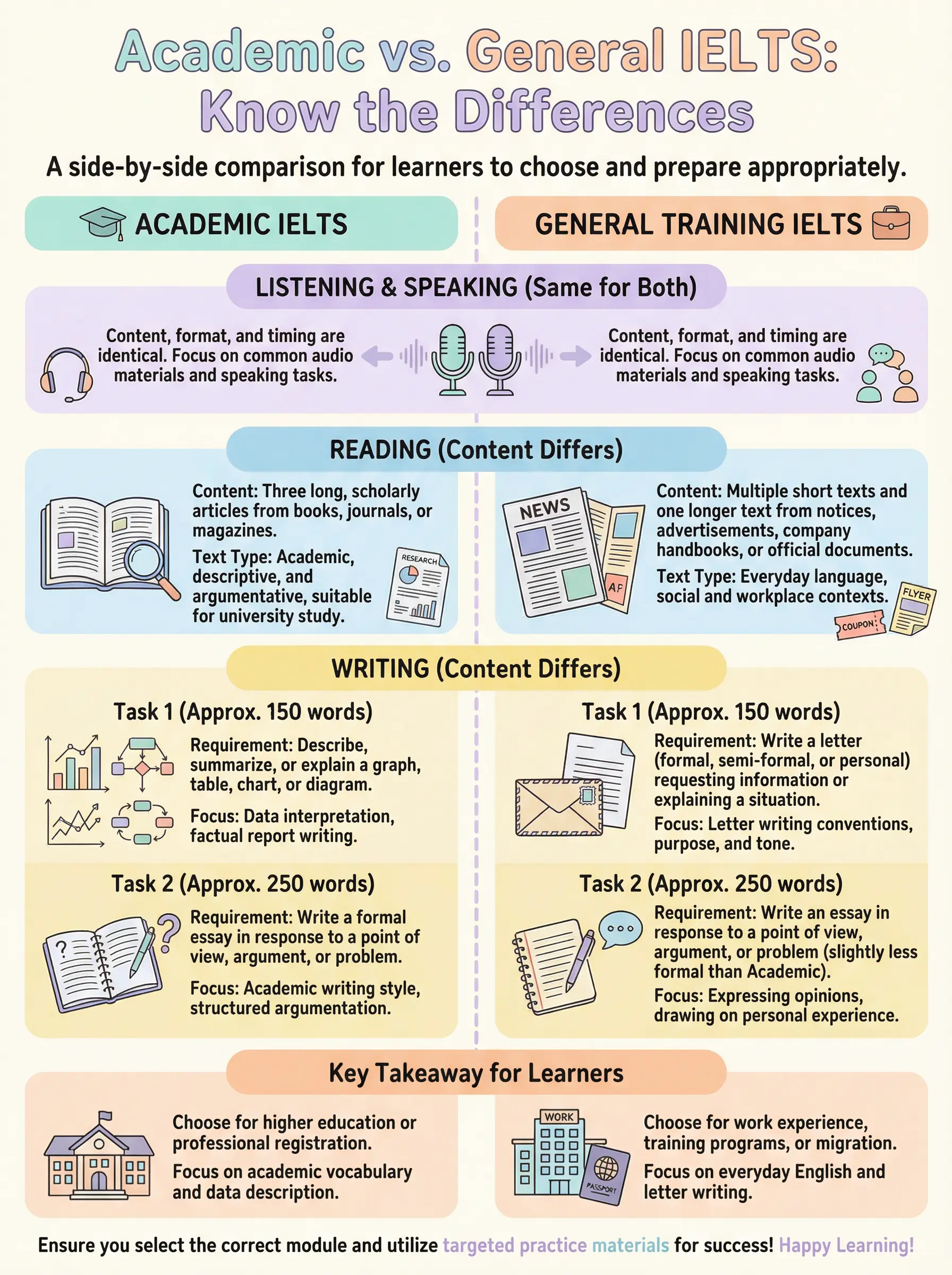
- •IELTS Academic: This is for people applying for higher education (university) or professional registration (e.g., doctors, nurses, engineers) in an English-speaking environment. It assesses if you are ready to begin studying or training in English.
- •IELTS General Training: This is for those going to English-speaking countries for secondary education, work experience, or migration (e.g., to Australia, Canada, New Zealand, or the UK). It focuses on basic survival skills in broad social and workplace contexts.
Always check with the organization you are applying to (university, government, employer) to confirm which version they require.
2. What is the Same?
Two sections of the test are identical for both Academic and General Training candidates. You will likely be in the same room taking these tests at the same time.
- •Listening: (30 minutes + transfer time). Both modules take the exact same Listening test. You will hear four recordings of native English speakers and then write your answers to a series of questions.
- •Speaking: (11–14 minutes). The Speaking test is also identical. It is a face-to-face interview with an examiner, covering short questions, a long turn (cue card), and a discussion.
3. The Reading Section: A Major Difference
While both reading tests have 3 sections and 40 questions to be completed in 60 minutes, the texts and the scoring are different.
IELTS Academic Reading
- •Content: Three long texts which range from the descriptive and factual to the discursive and analytical.
- •Source: Books, journals, magazines, and newspapers. They are written for a non-specialist audience but are appropriate for people entering university courses.
- •Scoring: The Academic reading test is generally considered harder in terms of vocabulary. Therefore, the scoring scale is slightly more "lenient" regarding the number of correct answers needed for a specific band. For example, getting 30/40 usually secures a Band 7.0.
IELTS General Training Reading
- •Content:
- •Section 1: Two or three short factual texts (e.g., hotel advertisements, notices).
- •Section 2: Two short, work-related factual texts (e.g., job descriptions, staff training materials).
- •Section 3: One longer, more complex text on a topic of general interest.
- •
- •Source: Notices, advertisements, company handbooks, official documents, books, and newspapers.
- •Scoring: Because the texts are generally simpler, the scoring is stricter. You typically need more correct answers to get the same band score. For example, to get a Band 7.0, you usually need 34/40 correct answers.
4. The Writing Section: Distinct Tasks
As detailed in our Writing Task Comparison post, the Writing modules differ significantly.
- •Task 1:
- •Academic: Describe a visual (graph, chart, map) formally.
- •General: Write a letter (formal, semi-formal, or informal) based on a situation.
- •
- •Task 2:
- •Both: Write an essay.
- •Difference: Academic essays often tackle more abstract topics, while General Training essays focus on more common, social topics.
- •
Conclusion
Understanding these nuances is key to your preparation strategy. If you are taking the General Training test, you must practice reading advertisements and work contracts quickly and accurately to meet the higher score threshold. If you are taking Academic, you need to get comfortable with dense, complex articles.
Focus your energy on the specific requirements of your module, and you will see faster progress toward your dream score.
Check out our other IELTS resources and practice tests to help you achieve your target band score!
Next best action
Move from strategy to score gains with a targeted practice step.