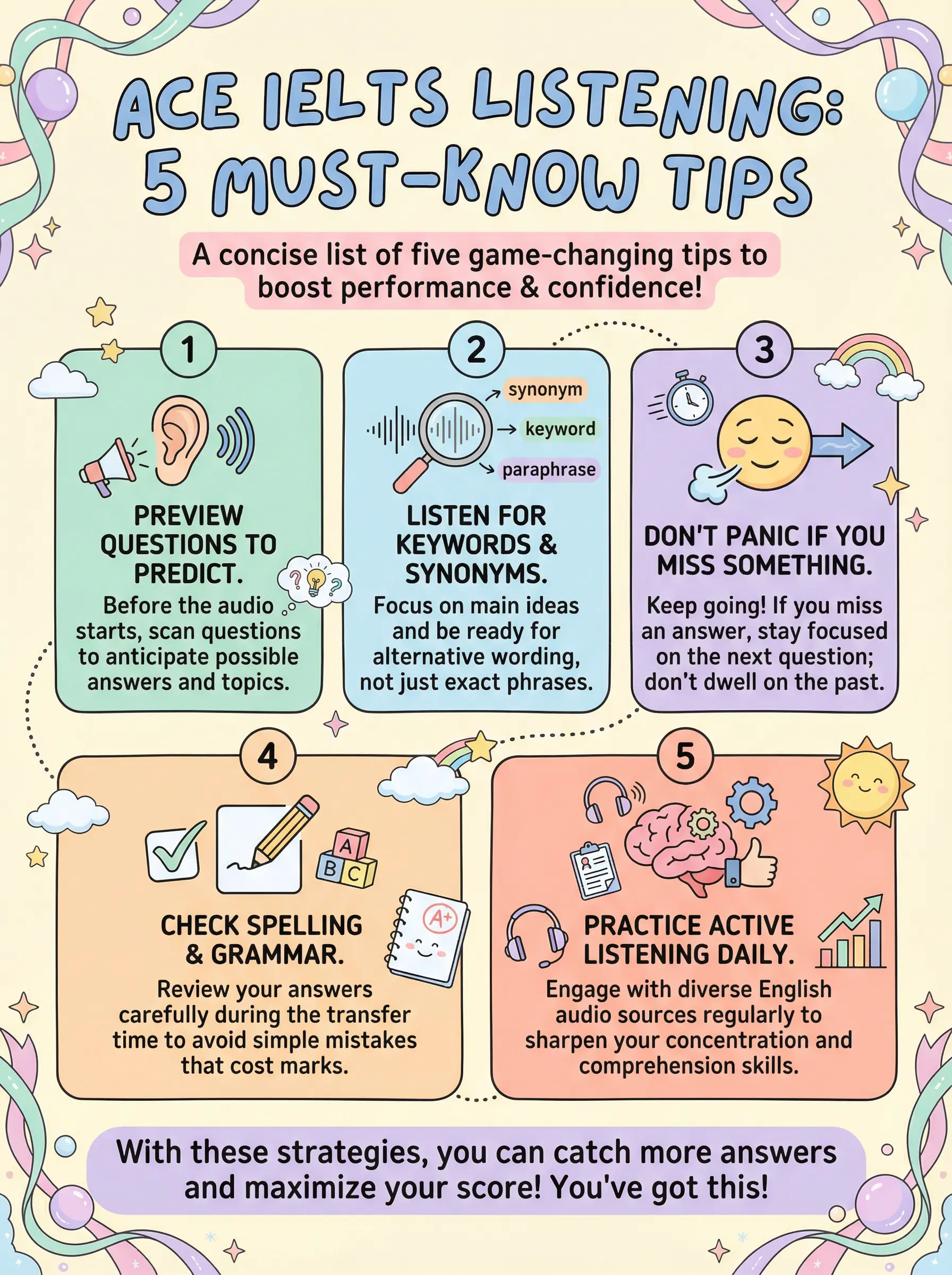
Ace IELTS Listening: 5 Strategies for a High Score
Ace IELTS Listening: 5 Must-Know Tips
The IELTS Listening test is unforgiving. You hear the audio only once. If your mind wanders for five seconds, you might miss three answers. To get a Band 7 or higher, you need more than just good ears; you need a strategy.
Here are 5 must-know tips to help you maximize your score.
1. Predict the Answers
You are given time before each section to read the questions. Use this time wisely. Do not just stare at the page; analyze it.
- •Grammar: Look at the gap. Does it need a noun, a number, a verb, or an adjective?
- •Example: "He bought a ______ shirt." (You know the answer is an adjective, probably a color or style).
- •
- •Context: What is the topic? If the title is "Library Membership," expect to hear words like "books," "borrow," "card," or "deposit."
- •Prediction: Guess what the answer might be. Even if you are wrong, predicting primes your brain to listen for specific information.
2. Beware of "Distractors"
IELTS loves to trick you. You will often hear the speaker say one thing, and then correct themselves.
- •Audio: "I'd like to book the table for 7:00 PM. Oh, wait, my friend finishes work late. Let's make it 7:30 PM."
- •Question: What time is the table booked for?
- •Trap: If you stopped listening after "7:00 PM," you got it wrong.
- •Strategy: Always wait for the speaker to finish the thought before confirming your answer. Listen for transition words like "however," "but," "actually," or "no, wait."
3. Synonyms are Your Best Friends
You will rarely hear the exact words from the question in the audio. You will hear synonyms or paraphrasing.
- •Question: "The price is inexpensive."
- •Audio: "It’s surprisingly cheap."
- •Question: "The course focuses on farming."
- •Audio: "The curriculum covers agriculture extensively."
If you are listening for the word "farming," you might miss "agriculture." Listen for the meaning, not just the matching words.
4. Don't Get Stuck
This is the golden rule of IELTS Listening. If you miss an answer, let it go immediately. If you panic and try to remember what was just said, you will stop listening to the current audio. This causes a "domino effect" where missing one question leads to missing the next five.
- •Strategy: If you aren't sure, guess quickly or leave it (you can guess later) and move your eyes to the next question instantly.
5. Be Careful with Transferring Answers
(Note: For Paper-based IELTS). You have 10 minutes at the end to transfer your answers to the answer sheet.
- •Spelling Counts: If the answer is "library" and you write "libary," it is wrong.
- •Grammar Counts: If the answer requires a plural "cats" and you write "cat," it is wrong.
- •Capitalization: It is generally safer to write your Listening (and Reading) answers in ALL CAPS. This solves the problem of wondering whether "london" needs a capital L (it does).
Conclusion
Success in IELTS Listening requires active, intense concentration. By predicting answers, watching out for traps, and staying calm if you miss a question, you can ensure that your listening skills translate into the score you deserve.
Check out our other IELTS resources and practice tests to help you achieve your target band score!
Next best action
Move from strategy to score gains with a targeted practice step.