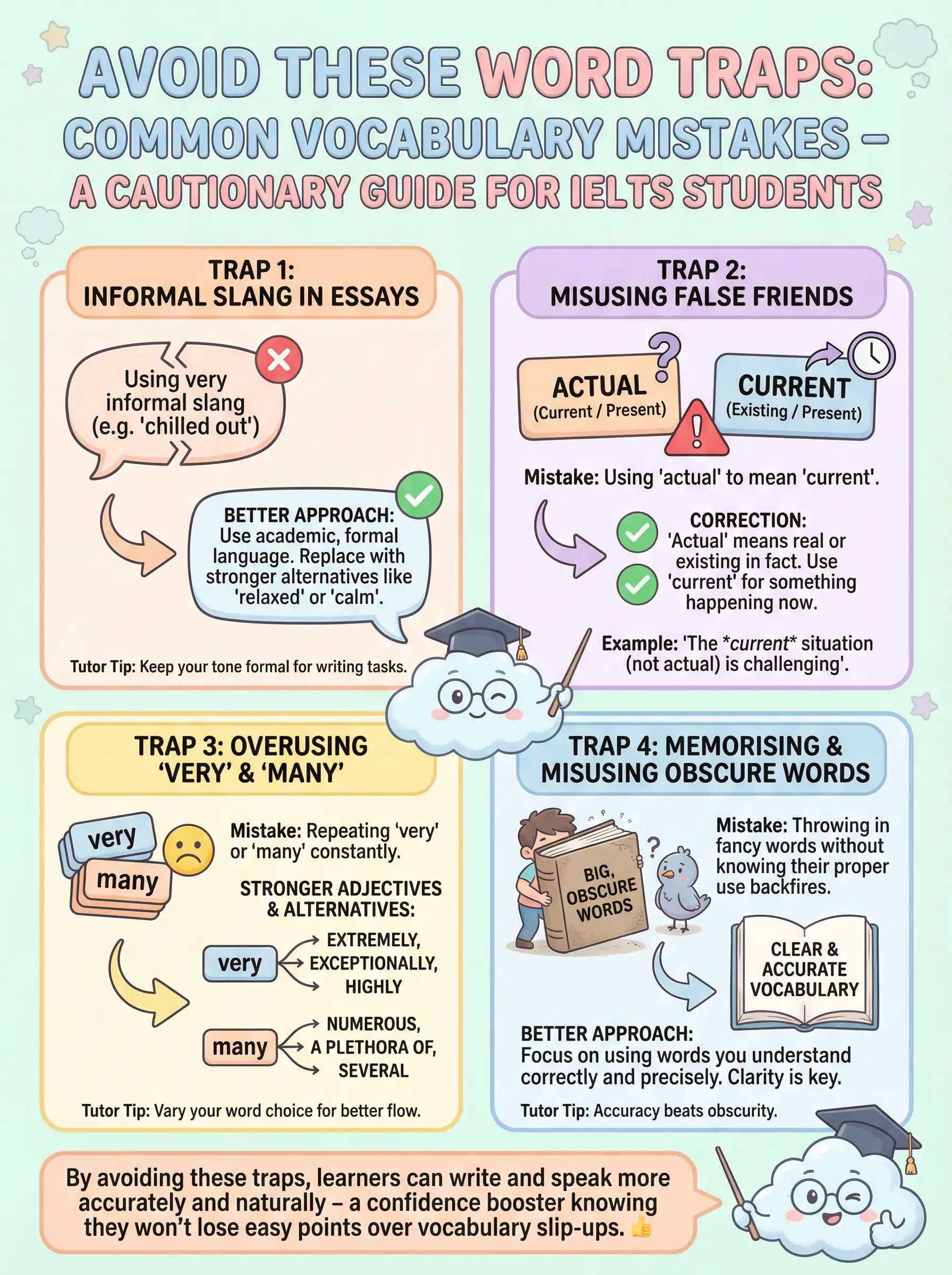
Avoid These Word Traps: Common Vocabulary Mistakes
Avoid These Word Traps: Common Vocabulary Mistakes
Vocabulary isn't just about using big words; it's about using the right words. Many students lose marks not because they don't know enough English, but because they use words inappropriately.
Here are the most common "Word Traps" that examiners see, and how to avoid them.
Trap 1: Informal Language in Writing
Academic Writing Task 2 must be formal. Avoid slang and casual speech.
- •Trap: "Kids today spend too much time on phones."
- •Fix: "Children / Young people today spend..."
- •Trap: "I want to hang out with friends."
- •Fix: "I want to socialize with friends."
- •Trap: "Stuff" / "Things"
- •Fix: "Items," "Factors," "Issues," "Possessions."
Trap 2: The "Very" Trap
Using "very" too much makes your writing weak and repetitive.
- •Trap: "The problem is very big."
- •Fix: "The problem is significant / substantial."
- •Trap: "This is very good."
- •Fix: "This is excellent / outstanding."
- •Trap: "It is very bad."
- •Fix: "It is detrimental / harmful."
Trap 3: False Friends (Confusing Words)
Some words look like words in your native language but have different meanings.
- •Trap: "Actually" (Used to mean "currently" by many European speakers).
- •English Meaning: "In reality" / "To be honest."
- •Correction: If you mean "now," use currently or at present.
- •
- •Trap: "Sensible" vs "Sensitive."
- •Sensible: Logical, practical.
- •Sensitive: Easily emotional / Careful with feelings.
- •
Trap 4: Making Up Words
Don't add suffixes (-tion, -ment, -ness) randomly to make a word sound "academic."
- •Trap: "The beautifulness of the city." (Wrong form).
- •Fix: "The beauty of the city."
- •Trap: "The importantness of the issue."
- •Fix: "The importance of the issue."
Conclusion
Accuracy beats complexity. If you aren't 100% sure of a "fancy" word, don't use it. Using a simple, correct word (like "children") is always better than using a slang word (like "kids") or a made-up word. Keep it formal, keep it accurate.
Check out our other IELTS resources and practice tests to help you achieve your target band score!
Next best action
Move from strategy to score gains with a targeted practice step.