Describe a Process: Academic Task 1 Made Simple
Describe a Process: Academic Task 1 Made Simple
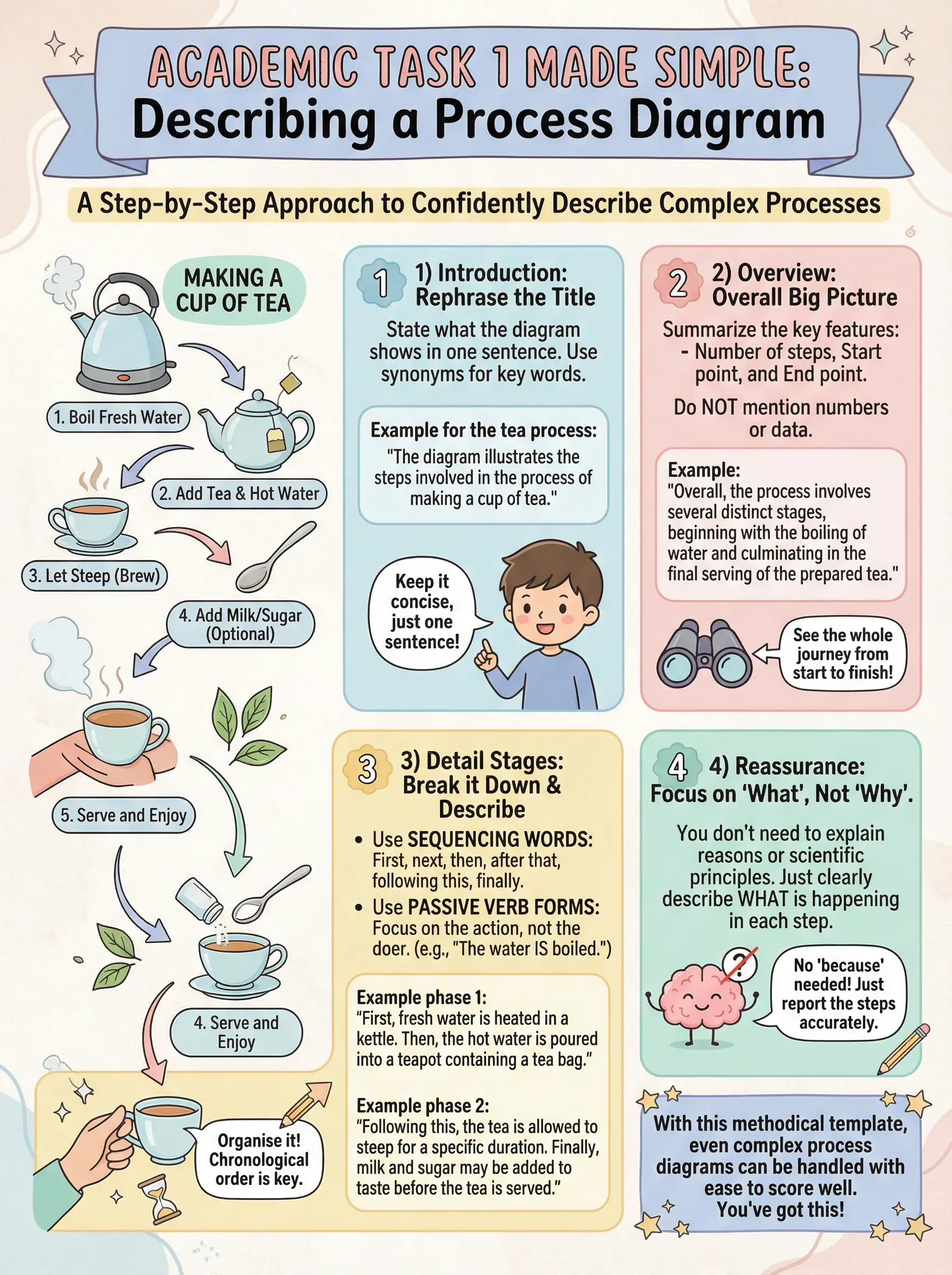
Many students fear the "Process Diagram" or "Map" in Writing Task 1 because they prepare only for bar charts and line graphs. But here is a secret: Process diagrams are often easier because you don't have to analyze trends or data. You just have to describe what you see.
Success in describing a process depends on two key grammar tools: Sequencers and Passive Voice.
1. The Structure
- •Introduction: Paraphrase the question.
- •Example: "The diagram illustrates the process of recycling plastic bottles."
- •
- •Overview: State the start point, the end point, and the number of main stages.
- •Example: "Overall, the process consists of five main stages, beginning with the collection of waste and culminating in the production of new products."
- •
- •Body Paragraphs: Describe the steps in detail, following the arrows logically.
2. Key Grammar: Passive Voice
In a process (like making chocolate or recycling), we don't care who does the action; we care about what happens to the object.
- •Active (Bad): "A worker picks the beans."
- •Passive (Good): "The beans are picked."
- •Examples: is heated, is ground, is transported, are separated, are filtered.
3. Key Vocabulary: Sequencers
You need to guide the reader from one step to the next. Do not just use "And then... And then... And then."
- •Start: First of all, To begin with, Initially.
- •Middle: Subsequently, Following this, Next, Then, After that.
- •Simultaneous: At the same time, While, During this phase.
- •End: Finally, Eventually.
4. Handling "Cyclical" Processes
Some processes are circles (like the water cycle or life cycle of a frog).
- •For these, emphasize that it is a repeating loop.
- •Example: "The cycle then begins anew."
Conclusion
Don't skip studying maps and processes! They appear frequently. If you master the "Passive + Sequencer" formula, you can write a high-scoring Band 7+ response in under 20 minutes with zero stress.
Check out our other IELTS resources and practice tests to help you achieve your target band score!
Next best action
Move from strategy to score gains with a targeted practice step.