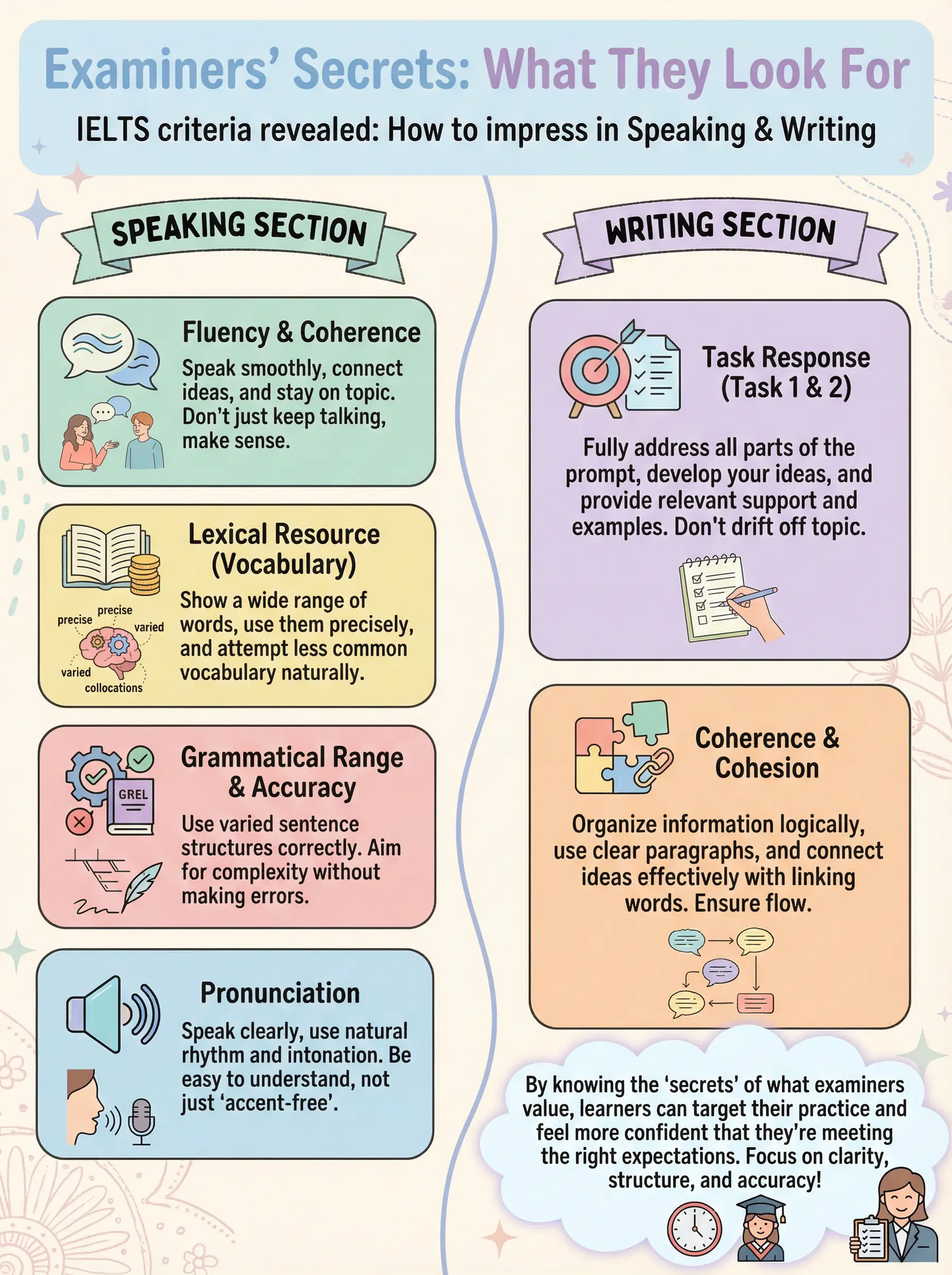
The IELTS examiner is not your enemy. They are not trying to trick you. They are simply listening (or reading) for specific evidence that matches the marking criteria. If you know what they are looking for, you can give it to them.
Here are the four pillars of assessment for the Writing and Speaking tests.
1. Fluency and Coherence (Speaking) / Task Achievement (Writing)
•
What it means: Can you keep talking without awkward pauses? Does your writing answer the specific question asked?
•
The Secret:
•
Speaking: Don't worry about "um" and "er" occasionally. Worry about long silences where you are searching for a word. Use fillers like "That's an interesting question..." to buy time.
•
Writing: Read the prompt twice. If it asks for "causes and solutions," and you only write about causes, you cannot get above a Band 5 for Task Response.
2. Lexical Resource (Vocabulary)
•
What it means: Do you have a wide vocabulary? Can you use words precisely?
•
The Secret: It's not about using the longest word in the dictionary. It's about using the right word.
•
Bad: "The weather was colossal." (Big word, wrong context).
•
Good: "The weather was severe."
•
Band 7+ Tip: Show you can use idioms and collocations (words that naturally go together) effectively.
3. Grammatical Range and Accuracy
•
What it means: Can you use a mix of simple and complex sentences? Do you make mistakes?
•
The Secret: "Range" is key. If you only write short, simple sentences ("I like cats. Cats are cute."), you are limited to Band 5/6.
•
Strategy: Practice using conditionals ("If I had time..."), relative clauses ("The man who..."), and passive voice. Accuracy matters, but don't be afraid to try complex structures.
4. Pronunciation (Speaking Only)
•
What it means: Can you be understood effortlessly?
•
The Secret: You do not need a British or American accent. You need clarity.
•
Focus on: Intonation (does your voice go up and down?), sentence stress (emphasizing key words), and individual sounds. If the examiner has to strain to understand you, your score drops.
Conclusion
There is no magic trick to fooling an examiner. They are trained to hear your true level. However, by aligning your practice with these four criteria, you ensure that your true level shines through and isn't hidden by nerves or misunderstanding the task.
Check out our other IELTS resources and practice tests to help you achieve your target band score!
Next best action
Move from strategy to score gains with a targeted practice step.