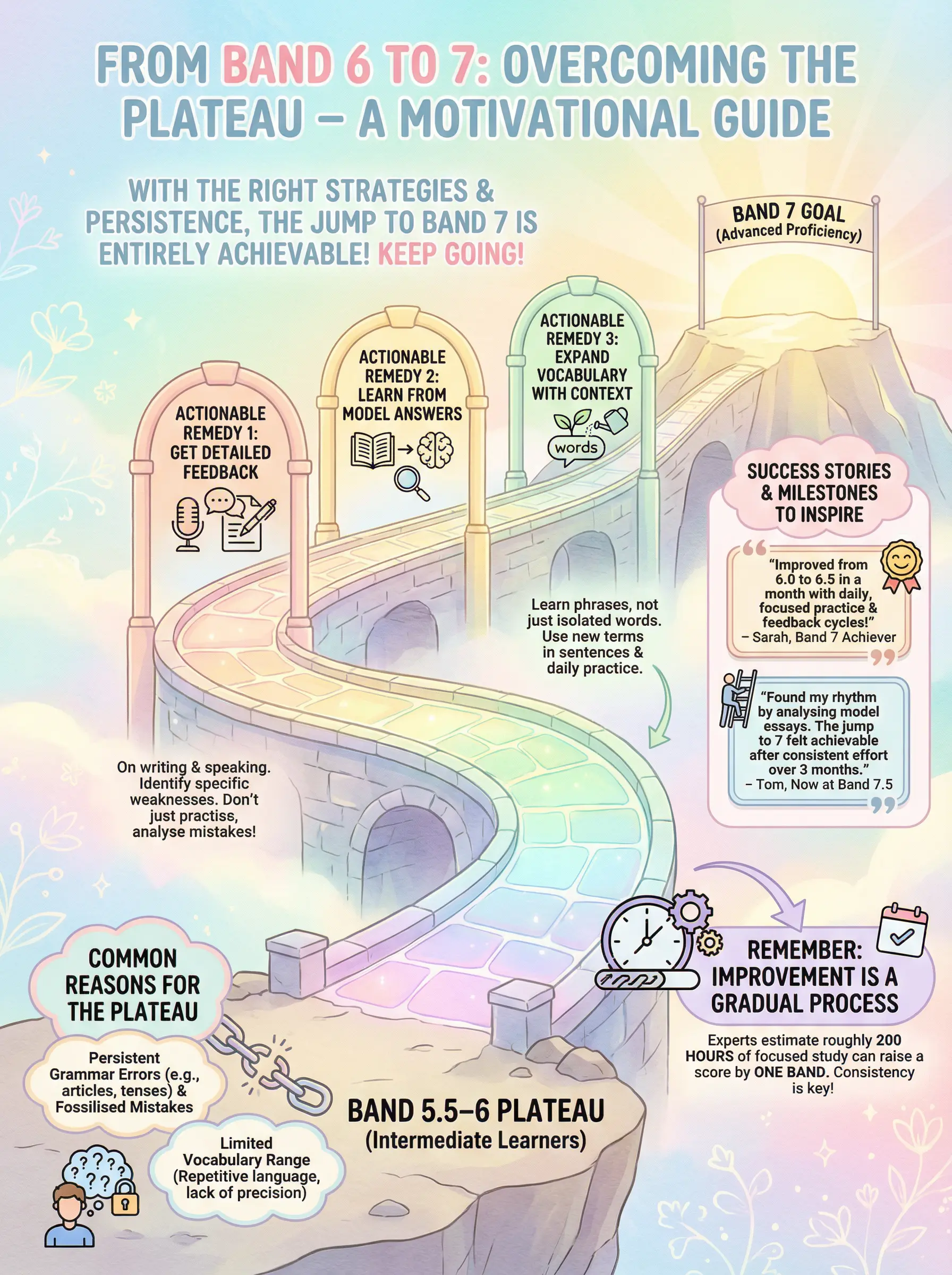
From Band 6 to 7: Overcoming the IELTS Plateau
From Band 6 to 7: Overcoming the IELTS Plateau
For many IELTS candidates, Band 6.5 is the "zone of frustration." You are competent in English; you can communicate effectively and understand most of what you hear. Yet, no matter how many practice tests you take, you can't seem to crack that Band 7 barrier.
This is what we call the "intermediate plateau." The strategies that got you to Band 6 (learning basic grammar, memorizing lists of words) won't get you to Band 7. To jump a band, you need a shift in strategy.
1. Diagnose the Problem: It's Not Just "More Practice"
Doing test after test without analyzing your mistakes will simply reinforce your bad habits. To reach Band 7, you need to know exactly where you are losing points.
- •Writing: Is your grammar accurate but simple? (Band 6). Or are you trying complex sentences but making frequent errors? (Band 6).
- •Speaking: Can you keep going without pausing? (Band 6). Or do you use a range of connectives and idiomatic language? (Band 7).
- •Reading/Listening: Are you getting stuck on the hardest 10 questions? Those are usually the difference between a 6.5 and a 7.5.
2. Upgrade Your Vocabulary: Context is King
Band 6 students know a lot of words. Band 7 students know how to use them naturally.
- •Collocations: Don't just learn the word "effort." Learn "make a concerted effort." Don't just learn "mistake." Learn "glaring mistake."
- •Topic-Specific Vocabulary: Move beyond generic words. instead of "good for the environment," use "environmentally sustainable" or "eco-friendly."
- •Precision: Stop using "big," "bad," and "good." Use "substantial," "detrimental," and "beneficial."
3. Grammar: Accuracy AND Range
For Band 7, you need "frequent error-free sentences." If every second sentence has a small mistake, you are stuck at Band 6.
- •Fix Persistent Errors: Do you always forget the 's' on third-person singular verbs? Do you struggle with articles (a/an/the)? Fix these basic errors first.
- •Complex Structures: You must show you can use subordinate clauses, passive voice, and conditionals.
- •Band 6: "Pollution is bad. The government should stop it."
- •Band 7: "Since pollution is becoming a detrimental issue, the government ought to implement stricter regulations."
- •
4. Writing Task Response: Answer the Question Deeply
In Writing Task 2, a Band 6 essay often addresses the topic generally. A Band 7 essay addresses the specific question asked.
- •Extend Your Ideas: Don't just list three reasons. Pick one reason, explain it fully, give an example, and show the result. Depth is better than breadth.
- •Clear Position: Your opinion must be clear from the introduction to the conclusion. Don't flip-flop.
5. Feedback is Essential
It is almost impossible to move from Band 6 to 7 in Writing and Speaking without feedback. You cannot see your own blind spots.
- •Find a Teacher/Tutor: Get someone to mark your essays specifically against the band descriptors.
- •Record Yourself: Listen to your speaking practice. Do you hear a lot of "um," "uh," or basic repetition?
Conclusion
Breaking the Band 6 plateau requires a shift from "quantity of practice" to "quality of practice." Focus on precision, complex grammar, and deep analysis of your errors. It takes work, but the jump to Band 7 is the key that unlocks university admissions and migration opportunities.
Check out our other IELTS resources and practice tests to help you achieve your target band score!
Next best action
Move from strategy to score gains with a targeted practice step.