IELTS 101: A Beginner’s Guide to Getting Started
IELTS 101: A Beginner’s Guide to Getting Started
Starting your IELTS preparation can feel like standing at the base of a mountain. There is so much information, so many strategies, and new vocabulary to learn. But every successful journey starts with a map.
This guide serves as your roadmap for IELTS 101, breaking down the basics so you can start your preparation with confidence.
1. What is IELTS?
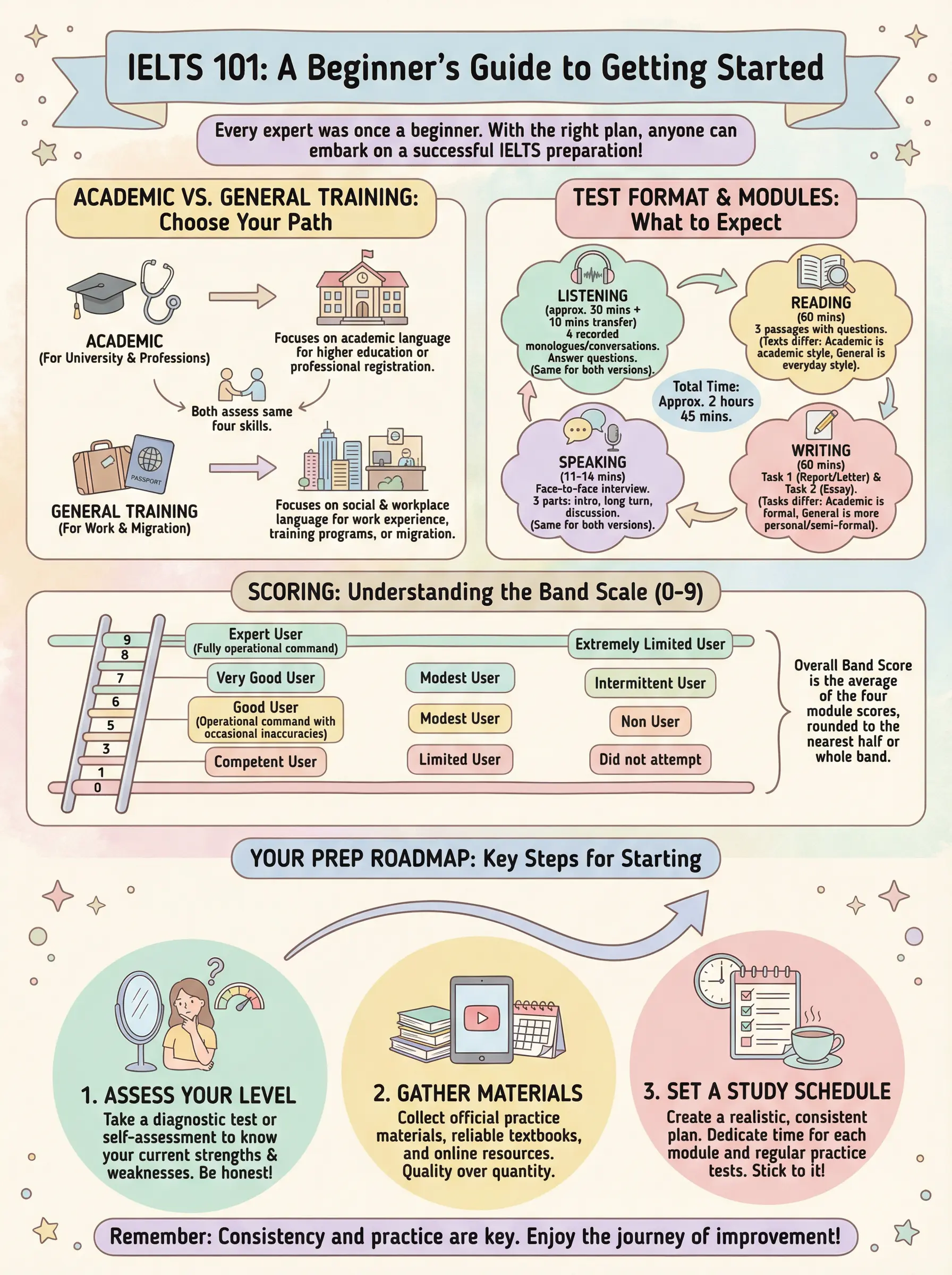
IELTS stands for International English Language Testing System. It is the world’s most popular English language proficiency test for higher education and global migration. It assesses your ability to communicate in English across four skills: Listening, Reading, Writing, and Speaking.
There are two main versions:
- •Academic: For university entry and professional registration.
- •General Training: For migration, work experience, or secondary education.
Tip: Check which version you need before you book!
2. Understanding the Band Scores
IELTS is scored on a scale of 0 to 9. You get a score for each of the four skills, and an overall band score (the average).
- •Band 9 (Expert User): Complete mastery of the language. Accurate, fluent, and appropriate.
- •Band 8 (Very Good User): Fully operational command with only occasional unsystematic inaccuracies.
- •Band 7 (Good User): Operational command, though with occasional inaccuracies and misunderstandings in some situations.
- •Band 6 (Competent User): Generally effective command despite some inaccuracies. Can understand and use fairly complex language.
Most universities require between a 6.0 and 7.5, depending on the course.
3. The Four Modules
The test always follows this order (Listening, Reading, Writing), with Speaking often held on a different day.
- •Listening (30 mins): 4 recordings, 40 questions. Accents range from British and Australian to American.
- •Reading (60 mins): 3 long texts, 40 questions. Academic texts are scholarly; General Training texts are from everyday life/work.
- •Writing (60 mins):
- •Task 1: Describe a chart/graph (Academic) OR Write a letter (General).
- •Task 2: Write an essay (Both).
- •
- •Speaking (11-14 mins): A face-to-face interview with an examiner.
4. Your First Steps to Success
Don't just dive into practice tests. Follow this smart preparation path:
- •Assess Your Level: Take a diagnostic test to see where you are now. This shows you the gap between your current level and your target score.
- •Understand the Format: Familiarize yourself with the question types (e.g., Multiple Choice, True/False/Not Given, Matching Headings).
- •Build a Habit: English isn't learned in a day. Set aside 30-60 minutes every day for practice. Consistency beats intensity.
- •Get Feedback: especially for Writing and Speaking. You can't spot your own mistakes easily.
Conclusion
The IELTS journey is a marathon, not a sprint. By understanding the format and setting clear goals from day one, you are already ahead of the pack. Take a deep breath, make a plan, and get started!
Check out our other IELTS resources and practice tests to help you achieve your target band score!
Next best action
Move from strategy to score gains with a targeted practice step.