Know Your Task: Academic vs General Training Writing
Know Your Task: Academic vs General Training Writing
Success in the IELTS Writing module depends on more than just language skill; it requires a strategic approach and a clear understanding of exactly what the examiners are asking for. One of the most common mistakes beginners make is mixing up the requirements for the Academic and General Training modules.
While the Listening and Speaking tests are identical for all candidates, the Writing section has distinct differences that you must understand to prepare effectively.
The Big Difference: Writing Task 1
The most significant difference lies in Task 1. This task accounts for one-third of your total Writing score, so getting it right is crucial.
IELTS Academic Task 1: The Report
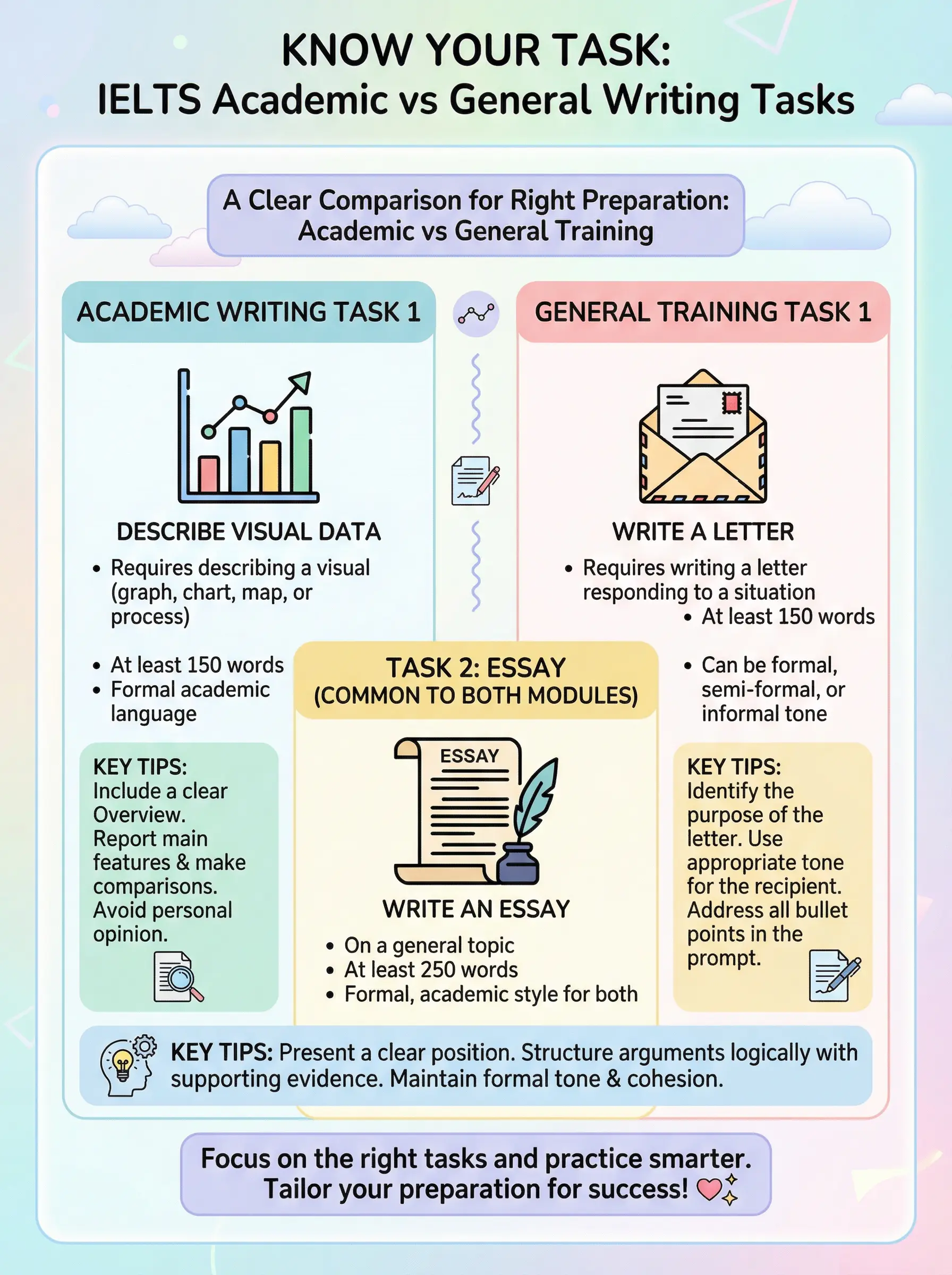
- •The Task: You are presented with a visual representation of information. This could be a line graph, bar chart, pie chart, table, map, or process diagram.
- •Your Goal: You must summarize the information by selecting and reporting the main features, and make comparisons where relevant.
- •Tone: Formal and objective. You should not give your opinion or use personal pronouns like "I" or "we".
- •Key Skills: Analyzing data, spotting trends, describing changes over time, comparing groups, and using specific vocabulary for data description (e.g., "fluctuated," "peaked," "plummeted").
IELTS General Training Task 1: The Letter
- •The Task: You are given a situation and asked to write a letter explaining the situation or requesting information.
- •Your Goal: You must address three bullet points provided in the prompt.
- •Tone: This depends on who you are writing to.
- •Formal: Writing to a manager or someone you don't know (e.g., applying for a job, complaining about a service).
- •Semi-formal: Writing to a neighbor or colleague.
- •Informal: Writing to a friend or family member.
- •
- •Key Skills: Understanding the appropriate tone (register), functional language (apologizing, requesting, inviting, thanking), and imagination (you often need to invent details to fill out the story).
The Nuanced Difference: Writing Task 2
Writing Task 2 is an essay for both modules, and it counts for two-thirds of your Writing score. While the format is similar, there are subtle differences in the topics.
Similarities
- •Format: Both require an essay of at least 250 words.
- •Time: You should spend about 40 minutes on this task.
- •Structure: Both require a standard essay structure: Introduction, Body Paragraphs, and Conclusion.
- •Assessment: You are marked on the same four criteria: Task Response, Coherence & Cohesion, Lexical Resource, and Grammatical Range & Accuracy.
Differences
- •Academic Task 2: The topics are generally more abstract and educational. You might be asked about education systems, crime and punishment, environmental issues, or globalization. The tone must be strictly formal.
- •General Training Task 2: The topics are often more related to daily life, social issues, or personal experiences. You might be asked about family life, television, shopping, or work-life balance. While still an essay, the style can be slightly more personal than the Academic essay, though a formal style is still safest.
Which Strategy Should You Use?
For Academic Candidates:
Focus heavily on data interpretation. Practice identifying the "Overview" – the most important trends in a graph. If you miss the overview in Task 1, you cannot score higher than a Band 5 for Task Achievement. For Task 2, read widely on academic topics to build your vocabulary and ideas bank.
For General Training Candidates:
Focus on tone awareness. Practice rewriting the same letter in formal and informal styles. For example, knowing the difference between "I am writing to inform you..." (Formal) and "Just wanted to let you know..." (Informal) is vital. For Task 2, practice generating ideas for social topics quickly.
Conclusion
By seeing the side-by-side differences, you can tailor your practice correctly. Don't waste time learning how to describe a bar chart if you are taking the General Training test, and don't practice writing letters if you are heading to university. Know your task, prepare the right strategies, and walk into the exam room with confidence.
Check out our other IELTS resources and practice tests to help you achieve your target band score!
Next best action
Move from strategy to score gains with a targeted practice step.