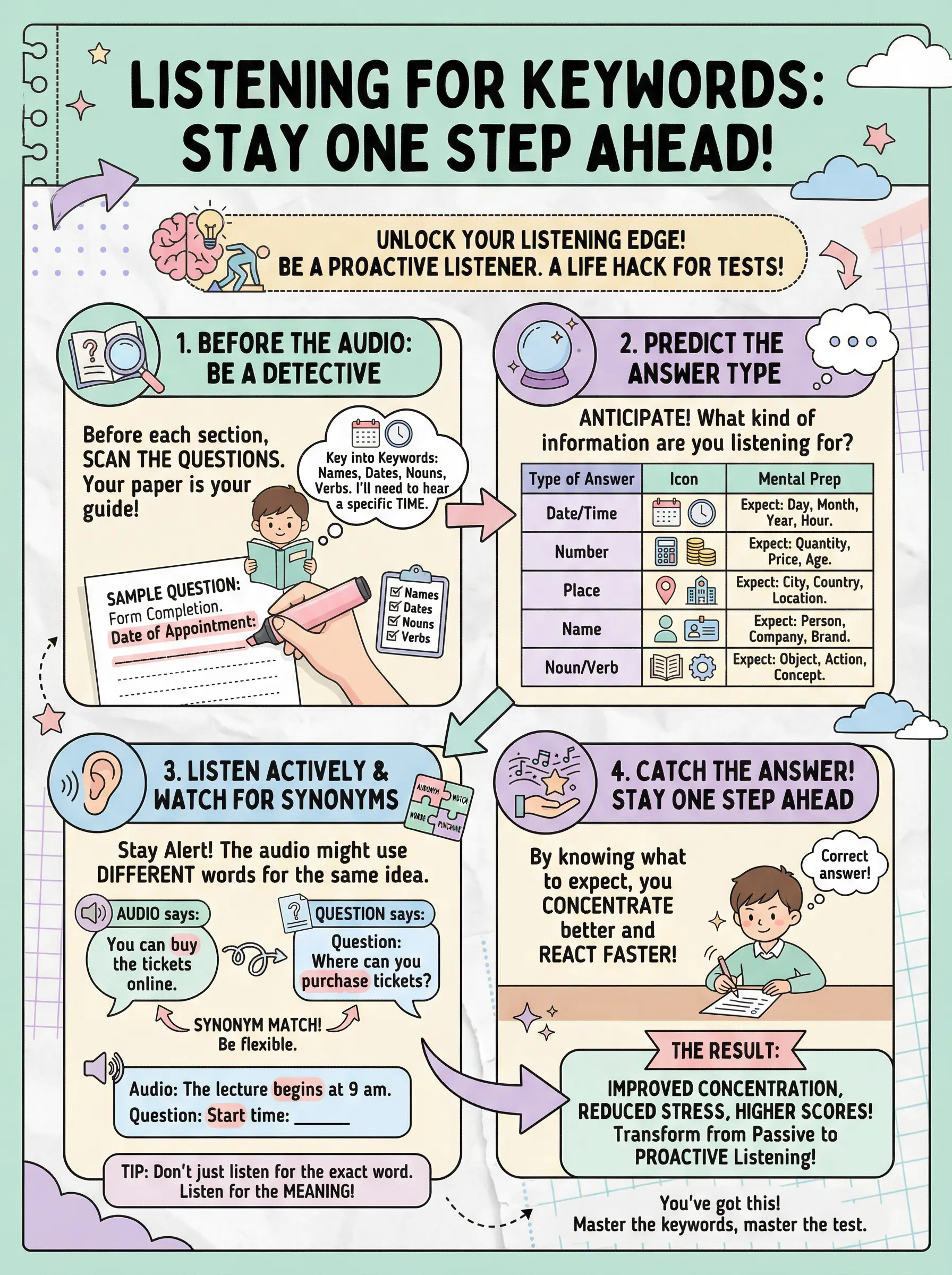
Listening for Keywords: How to Stay One Step Ahead
Listening for Keywords: How to Stay One Step Ahead
In the IELTS Listening test, if you are just listening and waiting for the answer to appear, you are already behind. To get a high score, you need to be an active listener. This means you are constantly hunting for specific information, using the question paper as your map.
The secret is identifying keywords. Keywords are the signposts that tell you where you are in the recording and when the answer is coming.
1. What Are Keywords?
Keywords are the unchangeable content words in the question. They are usually:
- •Names: (Dr. Smith, London, The British Museum)
- •Dates/Numbers: (1995, 25%, $50)
- •Nouns: (Library, Course, Flight)
These words are your anchors. You listen for them to know which question the speaker is addressing.
2. The Prediction Strategy
You have about 30 seconds before each section starts. Do not waste this time.
- •Underline Keywords: Quickly scan the questions and underline the nouns and names.
- •Predict the Answer: Look at the gap.
- •Question: "Meeting point: ________ Hall."
- •Keyword: Meeting point, Hall.
- •Prediction: It's a name. Probably "Main Hall" or "City Hall."
- •
When you predict, your brain is primed. You aren't just listening for anything; you are listening for a name.
3. "Signposting" Language
Speakers use specific words to signal that they are moving to the next point. These are crucial for following the flow.
- •"Moving on to..."
- •"Now, let's talk about..."
- •"On the other hand..."
- •"Finally..."
If you hear "Finally," and you are still looking at Question 2, you know you have missed the answers and need to jump to the end immediately.
4. The Synonym Trap
Be careful! The answer in the recording is often a synonym of the keyword in the question.
- •Question: "The course is compulsory."
- •Audio: "You must take this module."
- •Question: "The cost is high."
- •Audio: "It is quite expensive."
If you are listening only for the word "compulsory," you will miss "must." You need to listen for the concept, not just the word.
Conclusion
By identifying keywords and predicting answers, you turn listening from a passive activity into an active hunt. You stop chasing the audio and start anticipating it. This proactive approach helps you stay calm, focused, and one step ahead of the recording.
Check out our other IELTS resources and practice tests to help you achieve your target band score!
Next best action
Move from strategy to score gains with a targeted practice step.