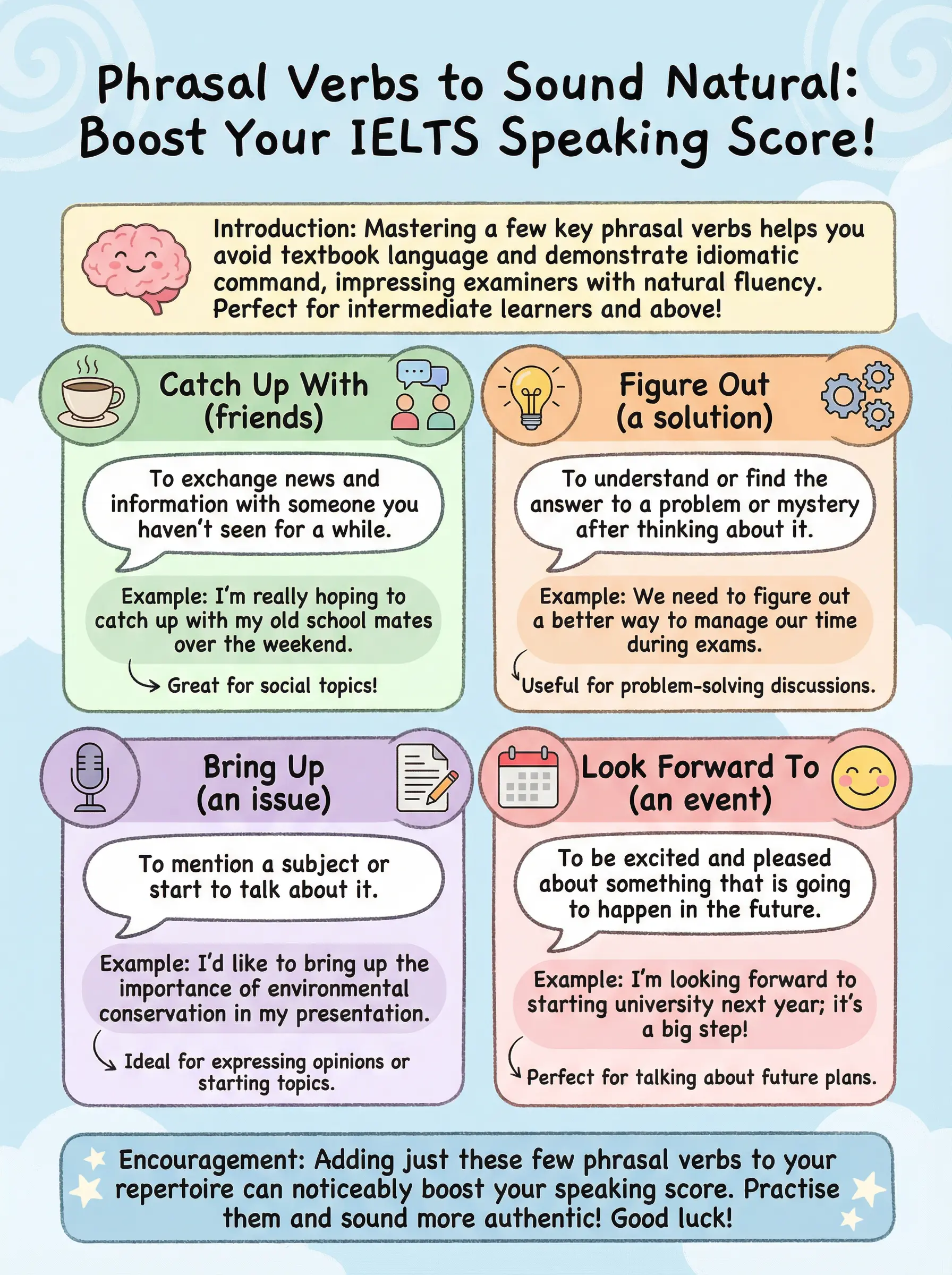
Phrasal Verbs to Sound Natural in IELTS Speaking
Phrasal Verbs to Sound Natural in IELTS Speaking
One of the key differences between a Band 6 and a Band 7+ in IELTS Speaking is the use of idiomatic language. Phrasal verbs are a huge part of this.
A phrasal verb is a combination of a verb + a particle (preposition or adverb) that creates a new meaning. For example, "give" means to offer something, but "give up" means to quit. Native speakers use these constantly in conversation. Using them correctly shows the examiner you have a natural command of English.
Here are some essential phrasal verbs categorized by common IELTS speaking topics.
1. Work and Study
- •Catch up on: To do something you didn't have time to do earlier.
- •Example: "I need to catch up on my reading assignments this weekend."
- •
- •Burn out: To become extremely tired or sick by working too hard.
- •Example: "If I work every weekend, I think I will burn out."
- •
- •Drop out: To leave a school or university before your course is finished.
- •Example: "He decided to drop out of college to start a business."
- •
- •Put off: To delay doing something (procrastinate).
- •Example: "I always put off writing essays until the last minute."
- •
2. Daily Life and Habits
- •Get up: To get out of bed.
- •Example: "I usually get up at 7 AM."
- •
- •Cut down on: To reduce the amount of something.
- •Example: "I'm trying to cut down on sugar to get healthier."
- •
- •Take up: To start a new hobby or activity.
- •Example: "I recently took up yoga to help me relax."
- •
- •Give up: To stop a habit.
- •Example: "It's really hard to give up smoking."
- •
3. Relationships and People
- •Get along with: To have a good relationship with someone.
- •Example: "I get along with my siblings very well."
- •
- •Look up to: To admire or respect someone.
- •Example: "I really look up to my father; he works so hard."
- •
- •Take after: To resemble a parent in appearance or character.
- •Example: "Everyone says I take after my mother."
- •
- •Catch up with: To talk to someone you haven't seen in a while.
- •Example: "It was great to catch up with my old school friends."
- •
4. Handling Problems
- •Figure out: To find a solution or understand something.
- •Example: "We need to figure out how to solve this pollution problem."
- •
- •Come up with: To think of an idea or plan.
- •Example: "The government needs to come up with a better strategy."
- •
- •Deal with: To handle or manage a situation.
- •Example: "I have to deal with difficult customers at work."
- •
Important Warnings
- •Don't Overuse Them: Using one or two phrasal verbs in an answer is great. Using five in one sentence sounds forced and unnatural.
- •Context Matters: Phrasal verbs are generally informal. They are perfect for the Speaking test and General Training Task 1 (Informal Letter). However, be careful using them in Academic Writing Task 1 or Task 2 essays, where formal verbs (e.g., "postpone" instead of "put off") are often better.
- •Grammar: Remember that phrasal verbs act like normal verbs. You must conjugate them correctly (e.g., "I took up" for past tense, not "I take up").
Conclusion
Adding a few well-chosen phrasal verbs to your speaking vocabulary is a "quick win" for your IELTS score. It pushes your Lexical Resource score up by demonstrating that you can use English flexibly and naturally, just like a native speaker.
Check out our other IELTS resources and practice tests to help you achieve your target band score!
Next best action
Move from strategy to score gains with a targeted practice step.