Range vs Accuracy: The Grammar Balance
Range vs Accuracy: The Grammar Balance
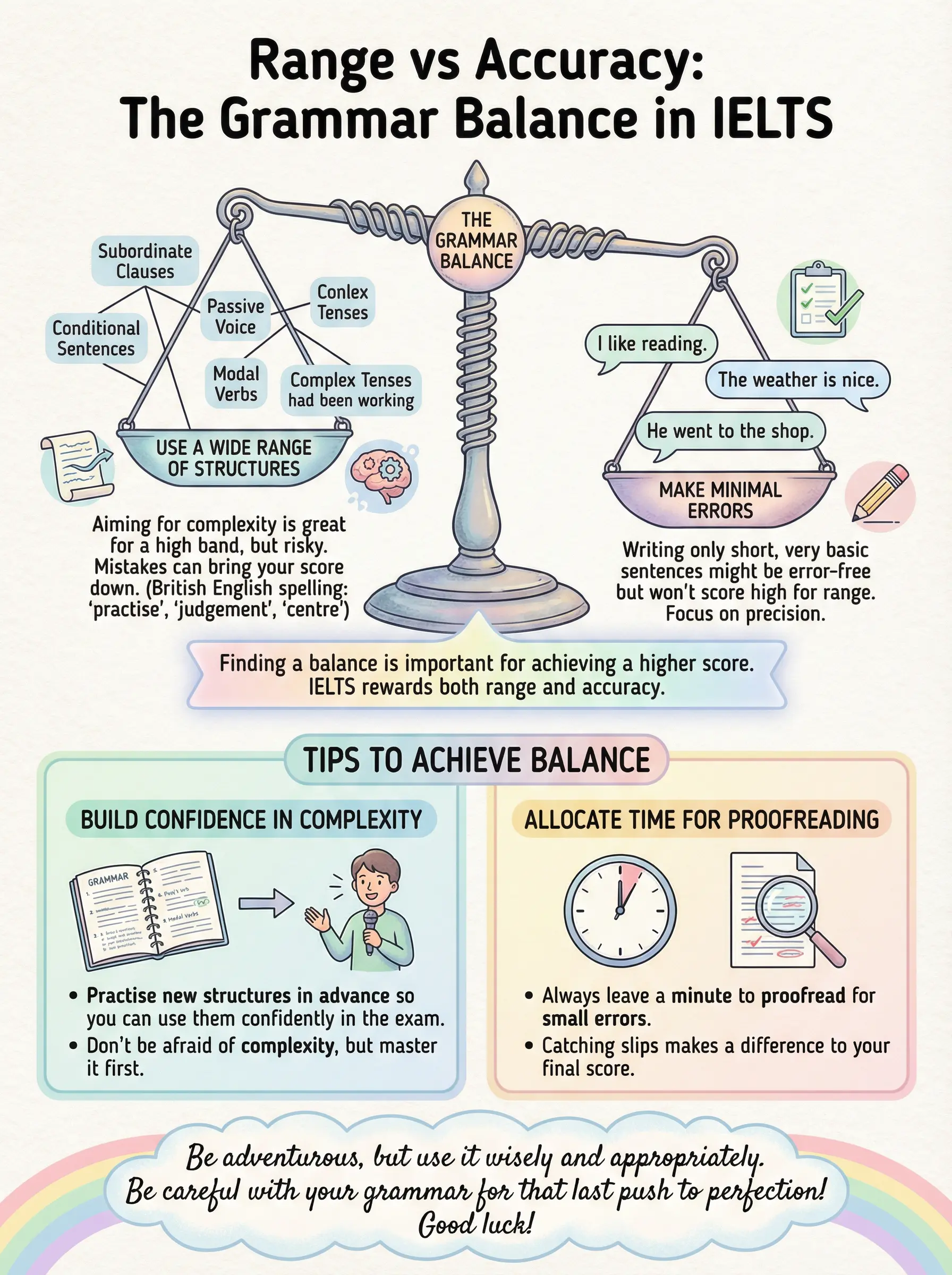
In the IELTS marking criteria for Writing and Speaking, grammar is judged on two things: Range and Accuracy. Many students focus 100% on Accuracy ("I must make zero mistakes") and end up with a low score because their Range is poor.
Understanding the balance between these two is the key to maximizing your score.
What is Accuracy?
Accuracy means "not making mistakes."
- •Example: "I go to school yesterday." (Inaccurate - wrong tense).
- •Example: "I went to school yesterday." (Accurate).
What is Range?
Range means "using a variety of structures."
- •Low Range: "I like pizza. It is tasty. I eat it often." (Simple, repetitive).
- •High Range: "Pizza, which is my favorite food, is delicious, though I try not to eat it too often." (Relative clause, contrast).
The Band Score Trade-Off
Band 5 / 6 Strategy: "Safety First?"
If you write simple sentences perfectly, you might get a Band 6 for Accuracy, but only a Band 5 for Range.
- •Result: Band 5.5.
- •Why: You didn't show the examiner you know advanced grammar.
Band 7+ Strategy: "Calculated Risk"
To get a Band 7, you need to show "a variety of complex structures." It is actually better to attempt a complex sentence and make a small mistake than to write only simple sentences perfectly.
- •Scenario A: "The graph shows numbers. They went up." (Zero mistakes. Low Range). -> Band 5.0
- •Scenario B: "The graph illustrate that numbers has increased significantly." (Two small mistakes. High Range attempts). -> Band 6.0/6.5 (because you attempted complexity).
The Sweet Spot
Of course, the goal is High Range + High Accuracy.
- •Don't overreach: Don't try to write a 5-line sentence with 4 clauses. You will get lost.
- •Master a few structures: Perfect your "Although" sentences, your "If" sentences, and your Passive voice.
- •Proofread: Spend the last 3 minutes checking for silly mistakes (Subject-verb agreement, articles).
Conclusion
Don't be paralyzed by the fear of making a mistake. The IELTS examiner wants to see what you can do, not just what you can't do. Show them your range!
Check out our other IELTS resources and practice tests to help you achieve your target band score!
Next best action
Move from strategy to score gains with a targeted practice step.