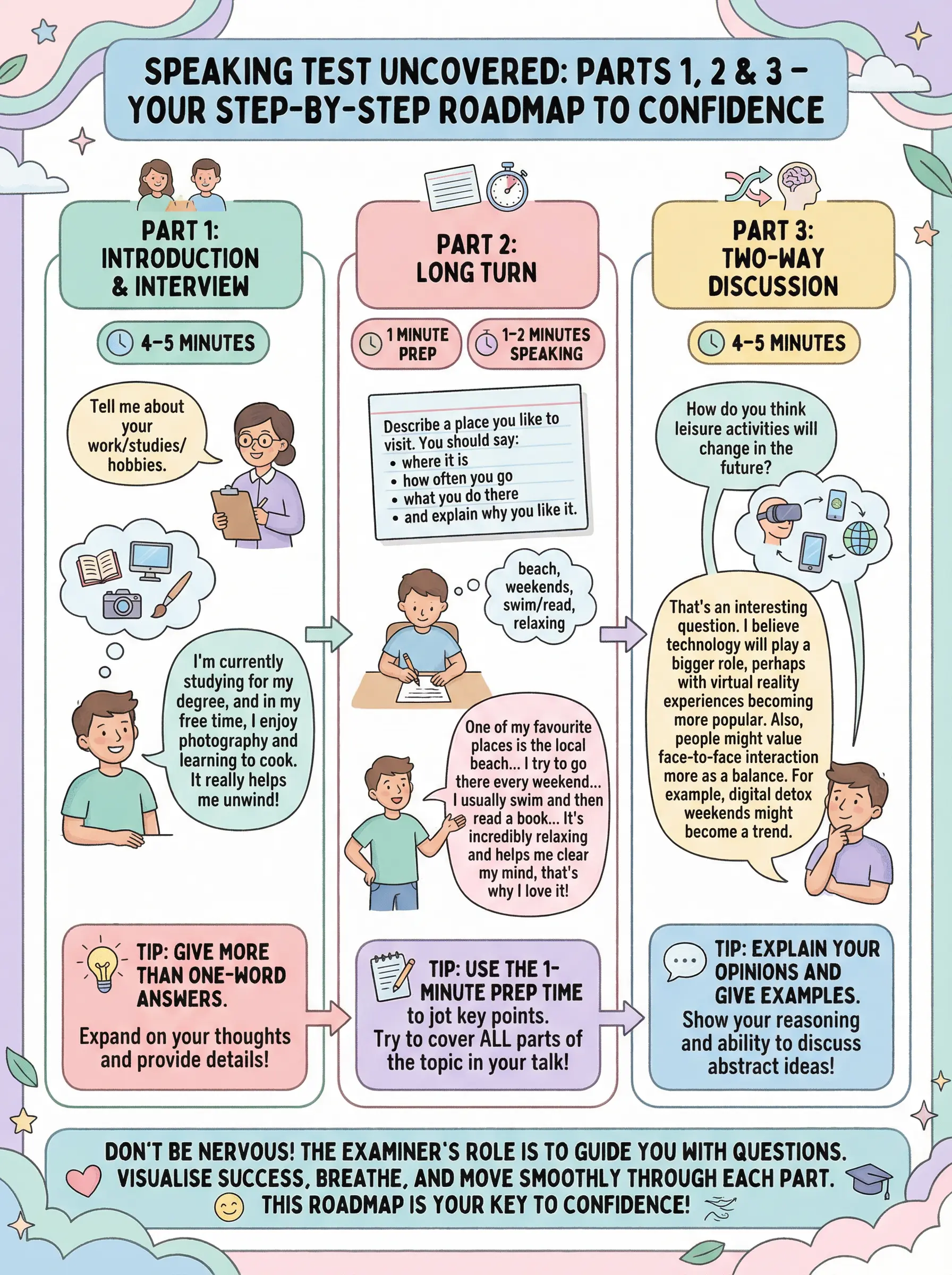
The IELTS Speaking test is a face-to-face interview that lasts between 11 and 14 minutes. It is designed to test your conversational skills, your ability to speak at length, and your ability to discuss abstract ideas.
Here is the breakdown of the three parts and what you need to do in each.
Part 1: Introduction and Interview (4-5 minutes)
•
What happens: The examiner asks general questions about you, your life, and familiar topics.
Strategy: This is a warm-up. Keep your answers conversational but complete. Don't give one-word answers.
•
Bad: "Yes."
•
Good: "Yes, I really enjoy it because..." (Answer + Reason).
Part 2: The Long Turn (3-4 minutes)
•
What happens: You receive a "Cue Card" with a topic. You have 1 minute to prepare and must speak for 1 to 2 minutes.
•
Topics: Describe a person, a place, an object, an event, or an activity.
•
Strategy:
•
Use the 1 minute effectively. Write keywords, not sentences.
•
Keep talking until the examiner stops you. If you stop at 1:15, you might lose marks for Fluency.
•
Tell a story. It's easier to keep talking if you are narrating an experience.
Part 3: Discussion (4-5 minutes)
•
What happens: The examiner asks deeper, more abstract questions related to the Part 2 topic.
•
Topics: Society, Education, Environment, Technology, Values. (e.g., "How has technology changed the way we travel?").
•
Strategy: This is the most important part for high scores. You need to give general, analytical answers, not personal ones.
•
Don't say: "My uncle hates cars."
•
Say: "Many older people find modern transport overwhelming..."
•
Use phrases like "It is generally considered that..." or "One major advantage is..."
Conclusion
The Speaking test gets harder as it goes on. Part 1 is easy chat. Part 2 is a monologue. Part 3 is a debate. By understanding this structure, you can shift your mindset and vocabulary to match the requirements of each section.
Check out our other IELTS resources and practice tests to help you achieve your target band score!
Next best action
Move from strategy to score gains with a targeted practice step.