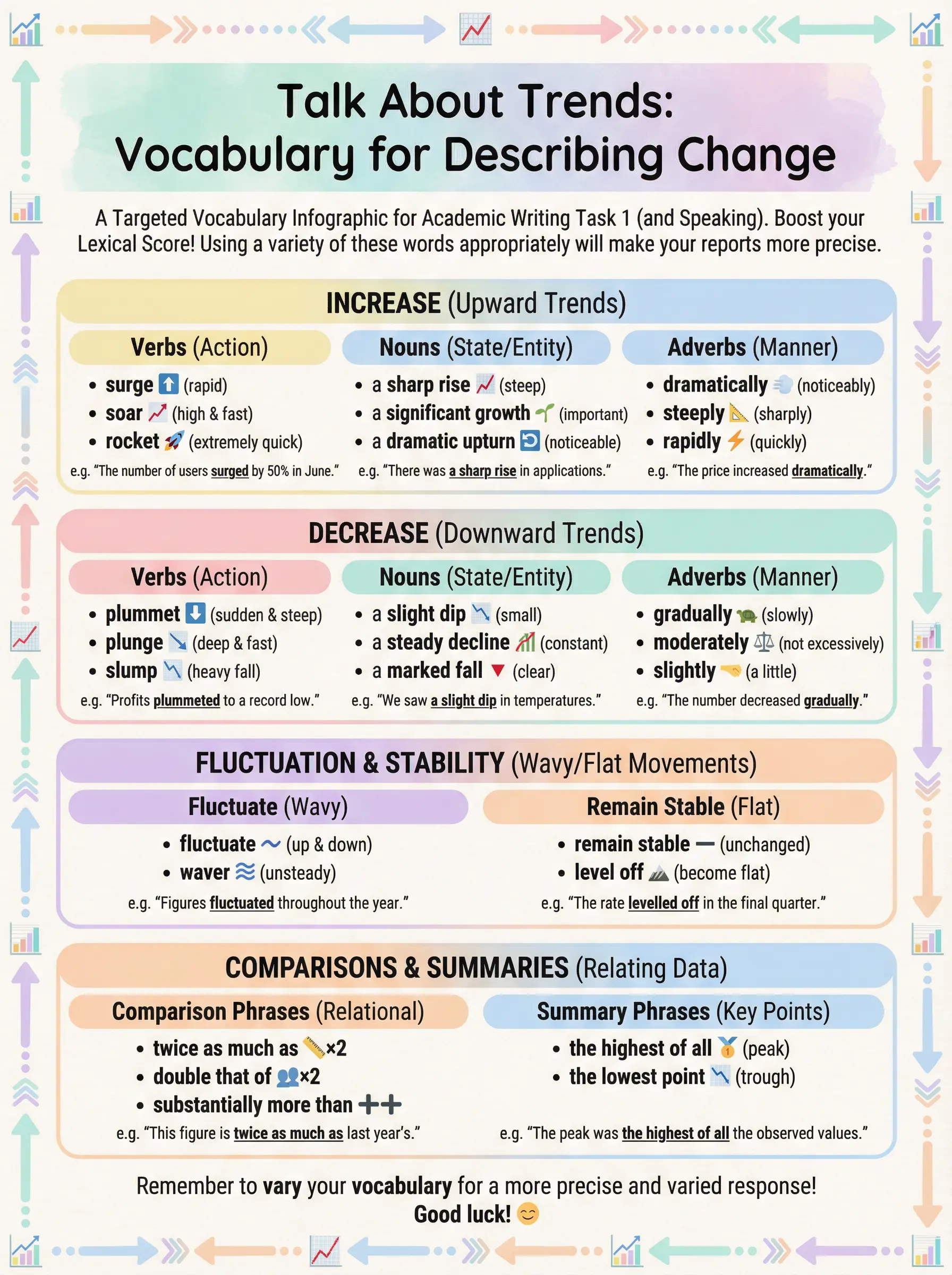
Talk About Trends: Vocabulary for Describing Change
Talk About Trends: Vocabulary for Describing Change
For Academic Writing Task 1, you usually need to describe a graph showing changes over time. Your score depends heavily on your Lexical Resource—your ability to use a variety of words to describe these movements.
Here is the essential vocabulary toolkit for describing trends.
1. Upward Movement (Increase)
- •Verbs: Rise, Increase, Grow, Climb, Go up.
- •Strong Verbs: Surge, Rocket, Soar, Jump. (Use these for big, sudden changes).
- •Example: "Sales rocketed in 2020."
2. Downward Movement (Decrease)
- •Verbs: Fall, Decrease, Drop, Decline, Go down.
- •Strong Verbs: Plummet, Plunge, Crash, Collapse.
- •Example: "Temperatures plummeted during the winter."
3. No Change / Ups and Downs
- •Stable: Remain stable, Remain steady, Stay constant, Level off, Plateau.
- •Unstable: Fluctuate, Vary.
- •Example: "Prices fluctuated between $50 and $60."
- •
4. Adverbs (How did it change?)
You need to describe the speed and size of the change.
- •Big/Fast: Significantly, Dramatically, Rapidly, Sharply, Substantially.
- •"Rose dramatically."
- •
- •Small/Slow: Gradually, Steadily, Slightly, Marginally, Slowly.
- •"Fell slightly."
- •
5. Nouns (Variety)
Don't always use Verb + Adverb ("It increased significantly"). Use Adjective + Noun ("There was a significant increase").
- •Structure A: "Sales fell slightly."
- •Structure B: "There was a slight fall in sales."
- •Structure C: "The period saw a slight fall in sales."
Conclusion
The key to a high score is variety. Do not repeat "increase" five times. Mix your verbs, use strong vocabulary for dramatic changes, and alternate between verb/adverb and adjective/noun structures. This shows the examiner you have full control over the language of data.
Check out our other IELTS resources and practice tests to help you achieve your target band score!
Next best action
Move from strategy to score gains with a targeted practice step.