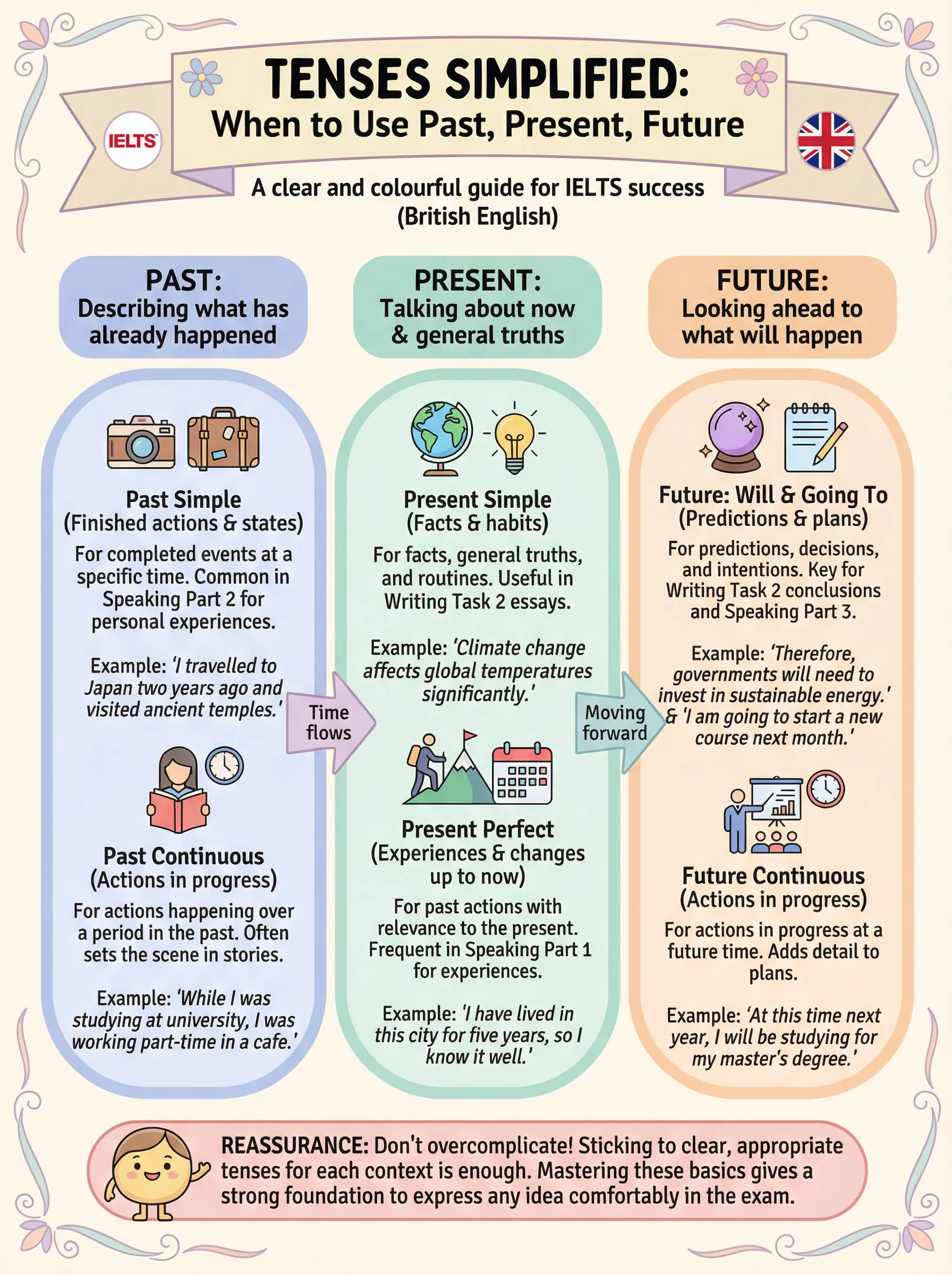
Tenses Simplified: When to Use Past, Present, Future
Tenses Simplified: When to Use Past, Present, Future
English has 12 tenses, but you don't need all of them to get a high IELTS score. You need to use the core tenses accurately.
Many students lose marks because they switch tenses randomly. The key is to ask yourself: "When is this happening?"
1. The Past: "It's Finished"
Use Past Simple for actions that started and finished in the past.
- •IELTS Context: Speaking Part 1 (talking about childhood), Part 2 (telling a story), Writing Task 1 (trends in the past).
- •Key Words: Yesterday, In 2010, Last year, When I was young.
- •Example: "I went to Paris last year." (It's done).
Use Past Continuous to set the scene or show an action in progress.
- •Example: "It was raining when I left the house."
2. The Present: "Facts and Now"
Use Present Simple for general truths, habits, and opinions.
- •IELTS Context: Writing Task 2 (General statements), Speaking Part 1 (Work/Study/Hobbies).
- •Example: "I work as a teacher." "Pollution affects health." "I agree with this view."
Use Present Continuous for things happening right now or temporary situations.
- •Example: "The climate is changing rapidly." "I am studying for IELTS."
3. The Bridge: Present Perfect
Use Present Perfect (Have/Has + V3) for past actions that connect to the present (experience or recent changes).
- •IELTS Context: Speaking Part 1 ("Have you ever...?"), Writing Task 1 (Introduction/Overview).
- •Key Words: Recently, Lately, Since, For, Ever, Never.
- •Example: "I have visited London twice." (In my life, up to now).
- •Example: "Technology has improved significantly." (And it is still improved now).
4. The Future: "Plans and Predictions"
Use Will for predictions or instant decisions.
- •IELTS Context: Speaking Part 3 (Future predictions), Writing Task 2 (Conclusion/Outlook).
- •Example: "I think AI will replace many jobs."
Use Going To for plans you have already made.
- •Example: "I am going to study abroad next year."
Conclusion
Don't try to force complex tenses (like Future Perfect Continuous) into your answers unless you are 100% sure. Using Past Simple, Present Simple, and Present Perfect accurately is enough to get a Band 7 or even 8. Clarity is power.
Check out our other IELTS resources and practice tests to help you achieve your target band score!
Next best action
Move from strategy to score gains with a targeted practice step.