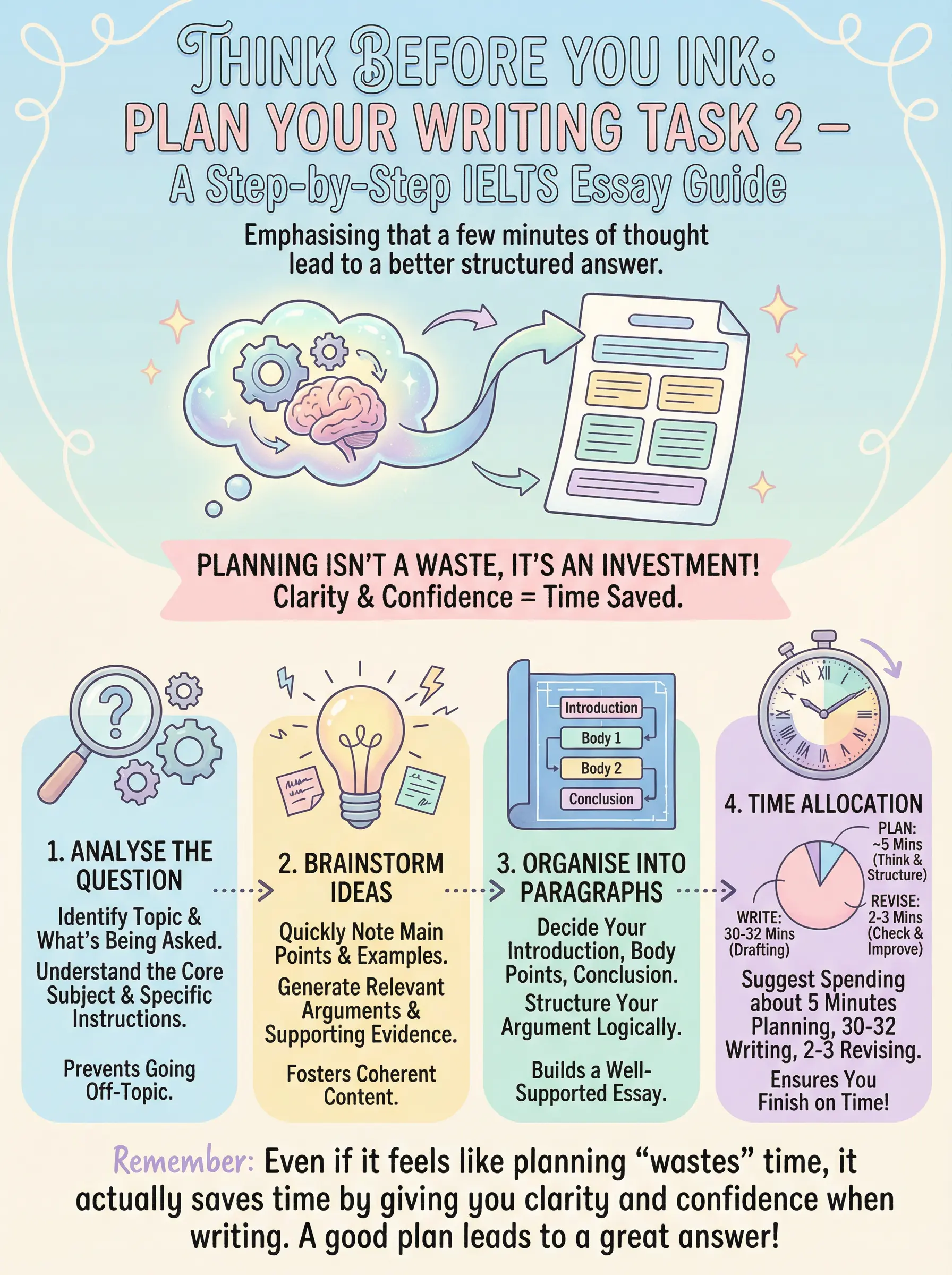
Think Before You Ink: How to Plan Your IELTS Writing Task 2
Think Before You Ink: How to Plan Your IELTS Writing Task 2
"I don't have time to plan!" This is the most common excuse IELTS students give for rushing straight into writing their essay. The truth is, you don't have time not to plan.
Starting to write without a plan is like driving to a new city without a map. You might get there eventually, but you'll likely get lost, take wrong turns (irrelevant ideas), and run out of gas (time) before you arrive. A 5-minute plan can save you 10 minutes of staring at the blank page and wondering what to write next.
Here is a strategic 4-step process to plan your IELTS Task 2 essay efficiently.
Step 1: Analyze the Question (1 Minute)
Before you generate ideas, you must be 100% sure what the question is asking. If you misinterpret the prompt, your Task Response score will suffer significantly.
- •Identify the Topic: What is the general subject? (e.g., Technology in Education).
- •Identify the Task: What exactly do you need to do? (e.g., Discuss both views and give your opinion? Do you agree or disagree? What are the causes and solutions?).
- •Underline Keywords: Highlight the specific words that limit the topic. For example, if the prompt says "technology in primary schools," talking about universities is off-topic.
Step 2: Brainstorm Ideas (2 Minutes)
Now, quickly generate ideas. Don't judge them yet—just get them out.
- •Mind Mapping: Draw a circle with the topic in the center and branch out with ideas.
- •The "Why" Technique: Ask yourself "Why is this true?" to generate supporting arguments.
- •Select the Best: You don't need 10 ideas; you need 2 really good ones that you can explain and support. Pick the strongest arguments that are easiest for you to explain in English.
Step 3: Structure and Organize (1 Minute)
Decide how you will group your ideas. A standard IELTS essay usually has 4 paragraphs:
- •Introduction: Paraphrase the question + Thesis statement (your opinion/outline).
- •Body Paragraph 1: First main idea + Explanation + Example.
- •Body Paragraph 2: Second main idea (or opposing view) + Explanation + Example.
- •Conclusion: Summarize main points + Restate opinion.
Pro Tip: Note down your main idea for Body 1 and Body 2. This is your roadmap.
Step 4: Time Allocation
Managing your 40 minutes is crucial. Here is a recommended breakdown:
- •Planning: 5-7 minutes. (Yes, really!)
- •Writing: 30 minutes. Since you have a plan, you can write continuously without stopping to think "what comes next?".
- •Checking: 3-5 minutes. Leave time to catch silly grammar and spelling mistakes.
Why Planning Improves Your Score
- •Coherence & Cohesion: A planned essay flows logically. Examiners look for a clear progression of ideas.
- •Task Response: Planning ensures you answer all parts of the question and don't go off-topic.
- •Vocabulary: While planning, you can note down some high-level vocabulary you want to use, ensuring you don't repeat the same words.
Conclusion
The "Think Before You Ink" strategy transforms writing from a stressful, chaotic experience into a structured, manageable task. Next time you practice, force yourself to put the pen down for the first 5 minutes. You'll be amazed at how much faster and better you write.
Check out our other IELTS resources and practice tests to help you achieve your target band score!
Next best action
Move from strategy to score gains with a targeted practice step.