Time Management Mastery for IELTS
Time Management Mastery for IELTS
You can have the vocabulary of a professor and the grammar of a novelist, but if you don't finish the test, you can't get the score. Time management is not just a skill; it is a survival requirement for IELTS.
Here is how to master the clock in every section.
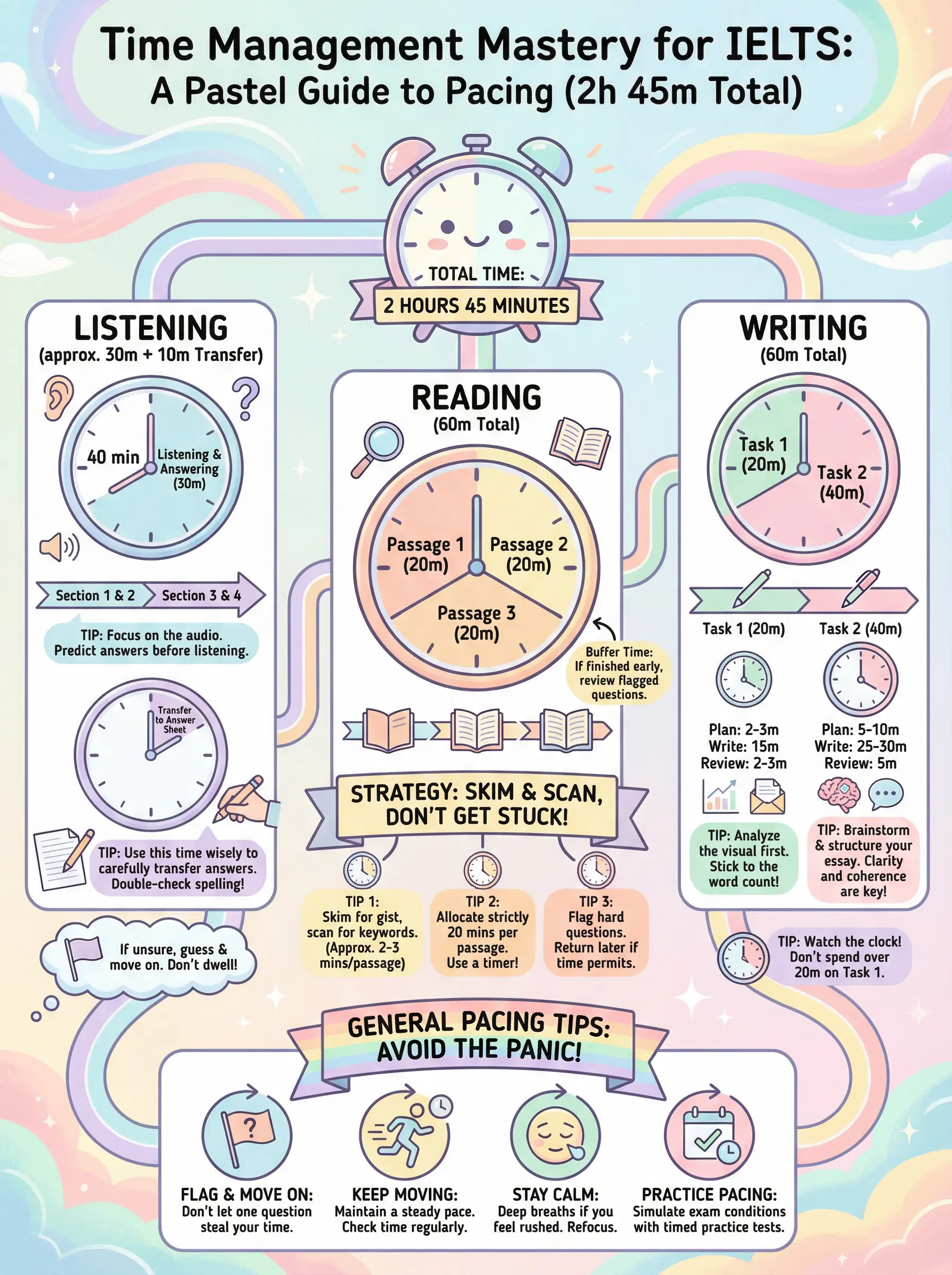
Reading: The 60-Minute Sprint
Most students try to spend 20 minutes on each of the three passages. This is a mistake because the passages get harder.
- •Passage 1 (Easiest): Aim for 15-17 minutes.
- •Passage 2 (Medium): Aim for 20 minutes.
- •Passage 3 (Hardest): Leave 23-25 minutes.
- •The Golden Rule: Never spend more than 90 seconds on one question. If you don't know it, guess, mark it, and move on. You can come back later if you have time.
Writing: The 1/3 Planning Rule
It feels counter-intuitive to sit and think when the clock is ticking, but planning saves time.
- •Task 1 (20 mins):
- •3 mins: Analyze the chart and Plan key features.
- •15 mins: Write.
- •2 mins: Check (grammar/spelling).
- •
- •Task 2 (40 mins):
- •5 mins: Plan ideas and structure. (Crucial!)
- •30 mins: Write.
- •5 mins: Check.
- •
- •Why plan? If you start writing immediately, you will likely get stuck halfway through or wander off-topic, forcing you to delete and rewrite. Planning ensures a linear, fast writing process.
Listening: The Look-Ahead Strategy
The audio never stops, but you have small breaks.
- •Before the audio starts: Read the questions. Underline keywords. Predict the answers (is it a number? a name? a date?).
- •During the break: Don't check your previous answers (you can't change what you heard). Look ahead to the next section. Being prepared for the next set of questions is worth more points than worrying about the last set.
Speaking: Control the Pace
- •Part 2 (The Cue Card): You have 1 minute to prepare. Use it! Write down keywords, not full sentences.
- •Speaking too fast: Nervousness makes you speed up. Breathe. Speak at a deliberate, natural pace. This gives you time to think of better vocabulary and grammar.
Conclusion
Time management is about discipline. Practice with a timer at home. Be strict with yourself. If you can beat the clock in practice, the real exam will feel like a walk in the park.
Check out our other IELTS resources and practice tests to help you achieve your target band score!
Next best action
Move from strategy to score gains with a targeted practice step.