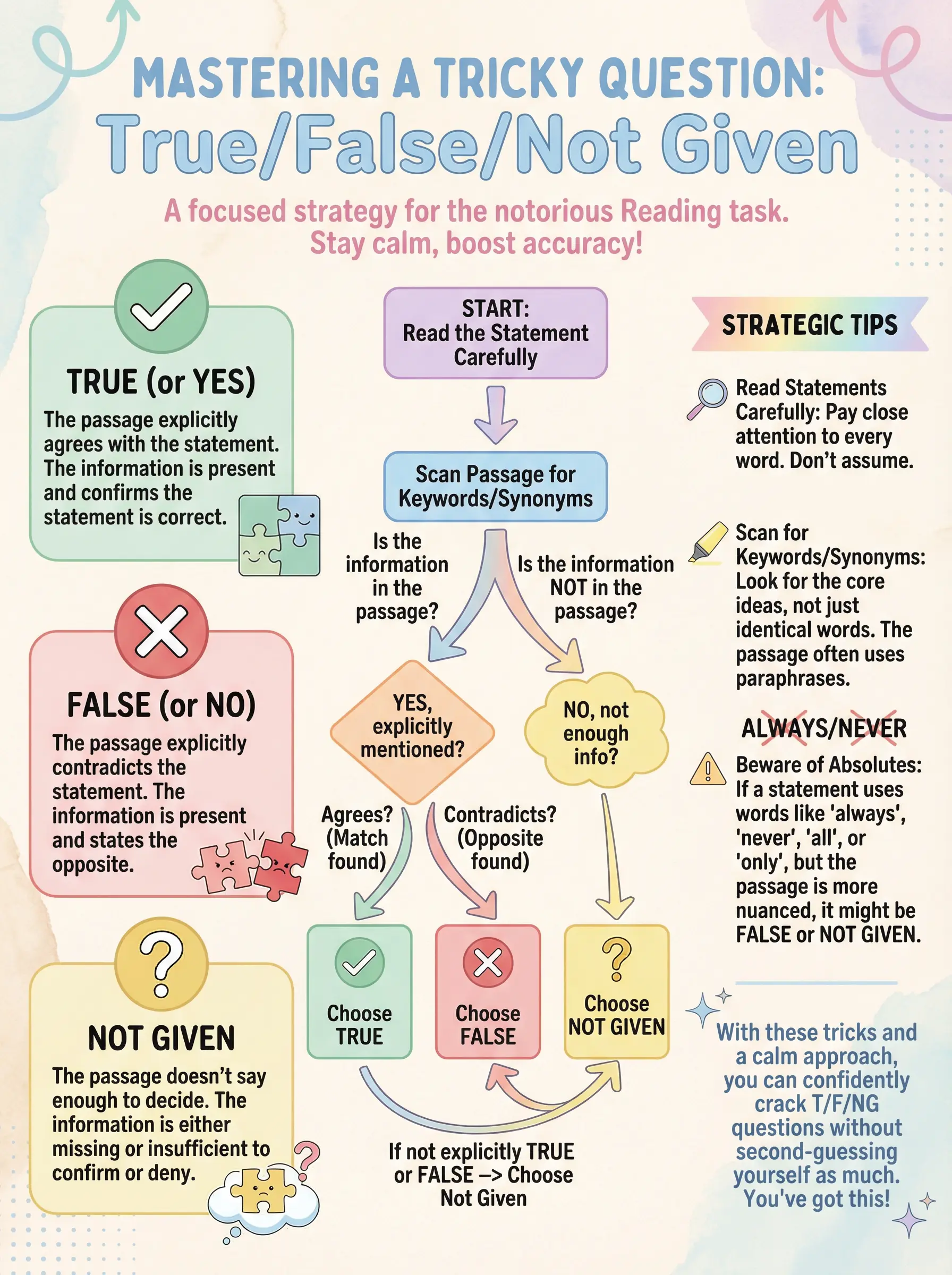
"True/False/Not Given" (or "Yes/No/Not Given") is widely considered the most difficult question type in the IELTS Reading test. Students often lose marks because they rely on their own knowledge or over-analyze the text.
The key to mastering this is understanding exactly what IELTS means by these three terms. It is a logic test, not just a reading test.
1. TRUE (or YES)
•
Definition: The statement agrees 100% with the information in the text.
•
The Check: Can you find a sentence in the text that means the exact same thing, even if the words are different (synonyms)?
•
Example:
•
Text: "The majority of the population relies on agriculture."
Definition: The statement contradicts the information in the text. The text says the opposite or something mutually exclusive.
•
The Check: Does the text prove the statement is wrong?
•
Example:
•
Text: "The birds migrate south in the winter."
•
Statement: "The birds stay in the same place all year."
•
Answer:FALSE (Migrating is the opposite of staying).
3. NOT GIVEN
•
Definition: The information is simply not there. You cannot know if it is true or false based only on the text.
•
The Trap: Students often think "But that is probably true in real life!" Stop. If it is not in the text, it is Not Given.
•
The Check: Does the text mention the topic but NOT the specific detail in the statement?
•
Example:
•
Text: "Dr. Smith discovered the cure in 1995."
•
Statement: "Dr. Smith was happy when he discovered the cure."
•
Answer:NOT GIVEN (The text tells us when and who, but it says nothing about his emotions. He might have been happy, but we don't know).
Common Traps to Watch
•
Qualifiers: Watch for words like all, some, mostly, rarely, never.
•
Text: "Some people like tea."
•
Statement: "All people like tea."
•
Answer:FALSE.
•
Comparison:
•
Text: "Coffee is popular in Brazil."
•
Statement: "Coffee is more popular in Brazil than in Chile."
•
Answer:NOT GIVEN (The text mentions Brazil, but does not compare it to Chile).
Conclusion
To succeed, be a robot. Don't assume, don't guess, and don't use outside knowledge. Ask yourself: "Does the text say YES, NO, or NOTHING?" Once you treat it as a logic puzzle, your accuracy will soar.
Check out our other IELTS resources and practice tests to help you achieve your target band score!
Next best action
Move from strategy to score gains with a targeted practice step.